John Petrucci
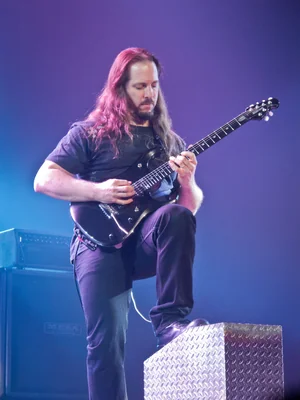
John Petrucci stands as a foundational figure in the development of late 20th and early 21st-century American musical structure, recognized primarily as an originating member of the progressive ensemble, Dream Theater. His artistic contribution extends significantly beyond his role as an instrumentalist, establishing him as a crucial architect responsible for the final presentation and aesthetic identity of the genre itself.
Petrucci’s sustained influence solidified through his methodical assumption of the producer role. Beginning in 1999 with the conceptually complex Metropolis Pt. 2: Scenes from a Memory, he initiated co-production oversight, ensuring the clarity and cohesion required for such demanding thematic material. This move signaled a pivotal shift toward total quality control in the studio environment, allowing him to supervise every phase of production, from initial composition to final mastering.
This trajectory of increasing artistic authority reached its full realization in 2011. With the release of A Dramatic Turn of Events, Petrucci became the band's sole producer, a position he has maintained subsequently. This singular focus ensures that each subsequent work is realized precisely to his structural specifications. Few modern artists maintain such rigorous control over the final iteration of their output; Petrucci’s consistent approach ensures the integrity of the original design, yielding complex, narrative-driven works that are frequently discussed in terms of museum-quality construction.
Beyond the institutional framework of Dream Theater, Petrucci has periodically presented independent studies, allowing for focused exploration of specific technical and expressive vocabularies. These projects, documented on solo albums such as Suspended Animation (2005) and the 2020 study Terminal Velocity, operate as essential indices to his ongoing technical and philosophical evolution. For scholars interested in the genesis of his design motifs, certain elements related to John Petrucci prints and early compositions occasionally enter the public domain, providing valuable downloadable artwork for archival study. His consistent evolution demonstrates a professional commitment to continuous self-improvement, which is perhaps the quietest mark of a truly great, long-career artist.
Source: Wikipedia · CC BY-SA 4.0