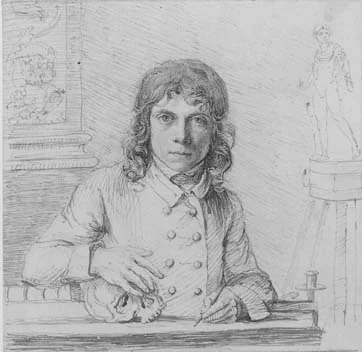
John Flaxman
John Flaxman stands as one of the definitive artistic forces in late eighteenth and early nineteenth-century Britain, a pivotal figure whose sculptural and graphic work profoundly shaped the aesthetic language of Neoclassicism across Europe. His career was characterized by a rare duality, spanning the high demands of public monument commission and the applied art of industrial design.
Flaxman’s early professional trajectory was cemented through his collaboration with Josiah Wedgwood. Working as a modeller for the celebrated pottery manufacturer, he gained crucial experience in interpreting classical subjects in low relief and ensuring artistic quality across commercially produced objects. This experience with serial design established a foundation for the elegant economy of line that would define his later work.
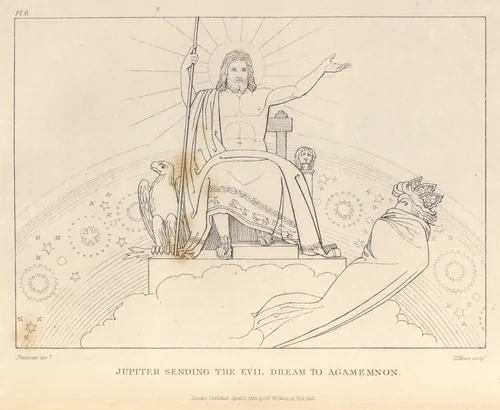
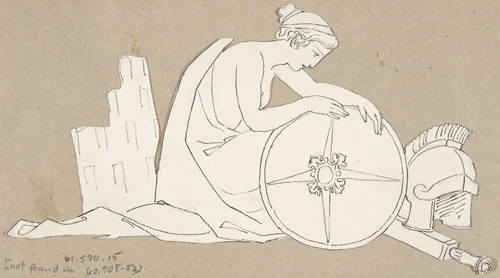
A crucial period of study in Rome immersed Flaxman fully in the remains of classical antiquity. During his time abroad, he transitioned from a studio sculptor into a highly influential draughtsman, producing the first of his celebrated book illustrations. These works, characterized by severe purity, focused on the human form in clear, dramatic outline, prioritizing movement and narrative clarity over textural depth. Drawings from this period, such as Frightened Man Looking Up; Woman and Children and the poignant Head of a Child in a Cap, are exemplary of his ability to convey complex emotion using the simplest graphic means. His ability to distill tragedy and domesticity into authoritative linear compositions rapidly disseminated his visual ideals across the continent through high-quality prints.
Flaxman returned to Britain celebrated, largely dedicating his subsequent decades to the production of funerary monuments. He became a prolific master in this highly public genre, replacing the baroque melodrama of previous generations with a sublime and accessible dignity. His memorials employed relief sculpture that spoke to private sorrow in universally recognized classical terms, establishing a solemn standard that redefined sculptural memorialization.
In a curious historical irony, a sculptor famed for monuments designed to ensure perpetuity in stone simultaneously ensured his visual legacy remained easily studied in the public domain. Today, scholars and enthusiasts benefit from his extensive surviving graphic output, including numerous studies like A Family Addressed by Angels, available as downloadable artwork.
Source: Wikipedia · CC BY-SA 4.0
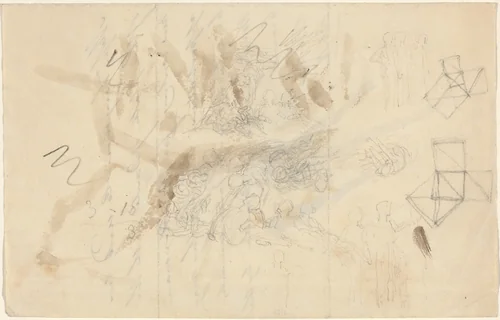
![Studies of a Sickbed and Decorations for the Façade of Buckingham Palace [recto and verso] by John Flaxman, drawing, 1820-1826](https://img.artbee.org/cec202c0-fcd4-40de-986d-845c65d0f3c2/small.webp)