John Anthony
John Anthony secured his historical position within the first wave of documentary photographers to capture the Near East, despite the exceptionally brief period of his documented activity between 1857 and 1860. Working in the challenging environment of mid-nineteenth-century Jerusalem, Anthony produced a concentrated, yet highly significant, series of nine known photographs that established enduring visual records of the region’s monumental sacred architecture.
The inherent difficulty of transporting and executing the collodion wet-plate process in the arid environment means that only highly dedicated or specifically commissioned photographers undertook such endeavors. Anthony’s surviving works, preserved in collections including the Metropolitan Museum of Art, attest to a remarkable technical proficiency and a sophisticated compositional eye. His images focus heavily on architectural detail and historical topography, serving both scholarly curiosity and the growing Victorian demand for authentic views of biblical lands.
Key images, such as Jerusalem, Court of the Mosque of Omar and Jerusalem, Site of the Temple on Mount Moriah, demonstrate a commitment to documenting complex spaces with clarity and precision, employing deep contrast to emphasize the texture of ancient stonework. Other known titles, including [Dome of the Holy Sepulchre, Jerusalem] and [Garden of Gethsemane and View of Jerusalem], illustrate his balanced approach to both interior sacred spaces and exterior topographical views. The consistency of quality across this small oeuvre suggests that Anthony arrived in Jerusalem with a clear agenda, executing his work with decisive efficiency before disappearing from the photographic record just three years later.
His output stands as a definitive representation of travel photography from the era, preceding the widespread availability of lighter, more manageable dry-plate technologies. Because these seminal nineteenth-century records have since entered the public domain, they remain crucial references for scholars and enthusiasts alike. Their enduring quality ensures that Anthony’s views are frequently reproduced as museum-quality prints, granting modern audiences continued access to these historically critical documents of a pivotal city.
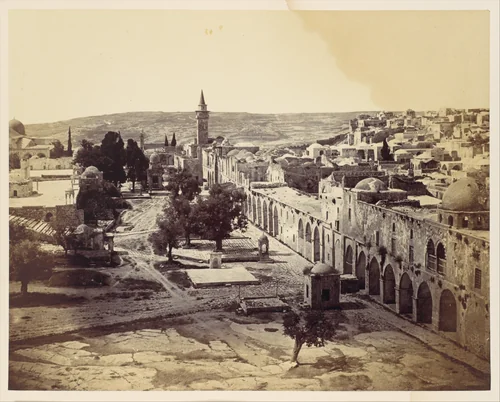
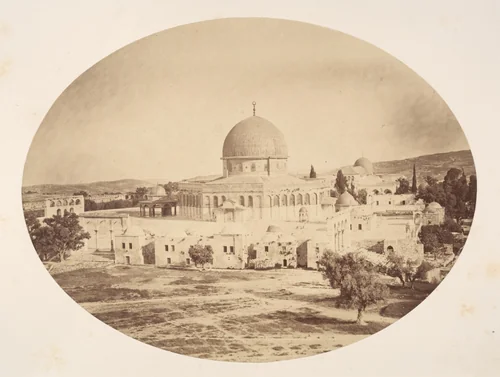
![[Jerusalem] by John Anthony, photograph, 1857](https://img.artbee.org/4bfa8245-d2bc-4717-aa18-c51e7e8f67ed/small.webp)
![[Dome of the Holy Sepulchre, Jerusalem] by John Anthony, photograph, 1860-1869](https://img.artbee.org/036f4a52-17f8-4b47-ba53-8cfb351e5dca/small.webp)
![[Garden of Gethsemane and View of Jerusalem] by John Anthony, photograph, 1860-1869](https://img.artbee.org/0d90b467-4f40-4c0b-9c84-55a36c353877/small.webp)
![[Garden of Gethsemane and the Tomb of the Virgin, Jerusalem] by John Anthony, photograph, 1860-1869](https://img.artbee.org/3cb41f7d-938f-4558-bd3a-03c3e0dee373/small.webp)
![[Jerusalem] by John Anthony, photograph, 1860-1869](https://img.artbee.org/cc34e097-2433-4751-849e-f20c166ecf3d/small.webp)
![[Tomb of Absalom, Zacharias, and St. James] by John Anthony, photograph, 1860-1869](https://img.artbee.org/4480e1af-df5e-40ef-865c-b02938ef05b0/small.webp)
![[Tomb of the Virgin, Jerusalem] by John Anthony, photograph, 1860-1869](https://img.artbee.org/3342e54a-6633-4013-817b-1395a6467e68/small.webp)