Johannes Riepenhausen
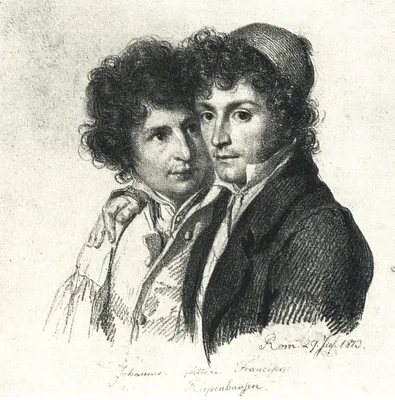
Johannes Riepenhausen (active 1795–1827) was a significant German draftsman and engraver of the early nineteenth century, primarily recognized for the work he undertook in Rome alongside his older brother, Franz Riepenhausen. Operating at the intersection of Neoclassicism and early Romanticism, the brothers became established figures within the active expatriate art community in the Papal States.
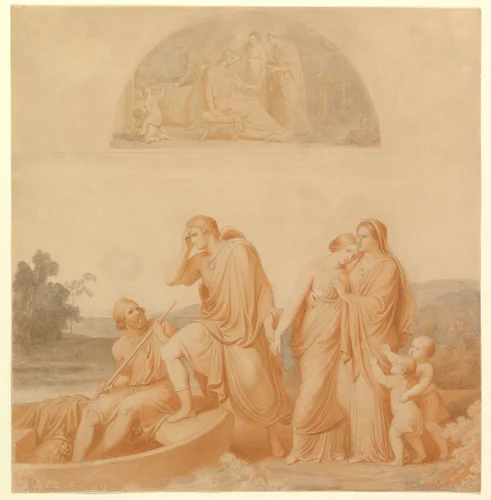
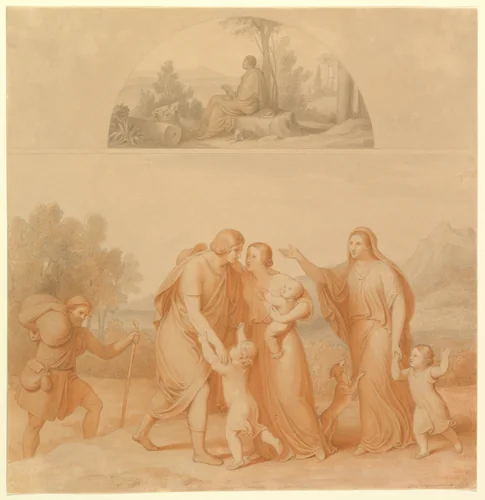
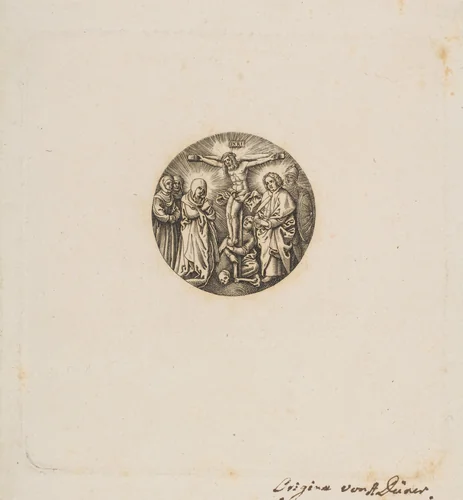
While the brothers often collaborated on major history paintings, Johannes distinguished himself through intimate, preparatory studies and finished drawings, many of which reside in prominent collections, including the Metropolitan Museum of Art. His subjects were invariably drawn from classical literature, religious narratives, and art historical iconography. Noteworthy examples of his draftsmanship include the paired conceptual works The Farewell and The Return, which exemplify the era’s fascination with emotional narrative arcs rendered through precise classical forms. A subtle but consistent strength in Riepenhausen’s production lies in his masterful handling of psychological weight within compact compositions, often employing circular or centralized formats, as seen in his moving interpretation of The Crucifixion (Round) (copy).
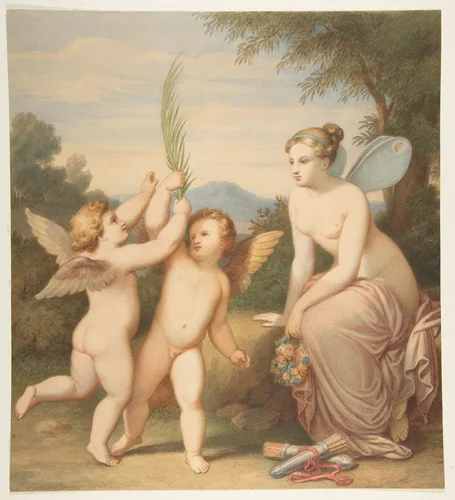
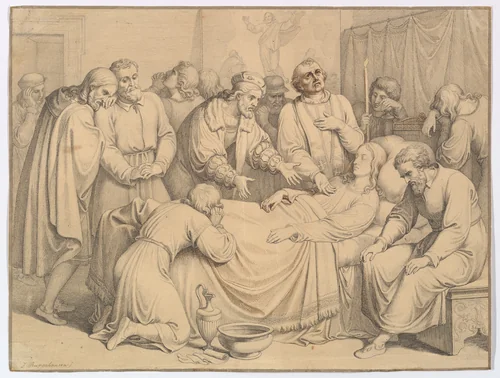
Riepenhausen’s engagement with classical themes extends beyond mere emulation. His drawing, Eros and Anteros with Psyche Looking at Them, demonstrates a sophisticated understanding of ancient mythology, presenting a tableau that is both academically correct and subtly charged with tension. Perhaps his most fascinating contribution to the genre of artistic homage is The Death of Raphael. Executed as a print, this piece reflects the Riepenhausen brothers’ deep reverence for the High Renaissance master and their commitment to preserving and reinterpreting foundational narratives of Western art.
As printmakers, the Riepenhausen brothers ensured their compositions achieved wide circulation, a key factor in their influence during the period. Today, a selection of these works remains important resources for students of German Neoclassicism. Many are now available as public domain images, offering easy access to museum-quality documentation of his process. Scholars and enthusiasts can find high-quality prints and downloadable artwork derived from his most accomplished drawings and prints, providing insight into the artistic rigor required of the German artists who transplanted their careers to Italy. The consistent quality across his relatively small surviving oeuvre confirms his status not merely as a brother's assistant, but as an assured artist in his own right.
Source: Wikipedia · CC BY-SA 4.0