Johannes Itten
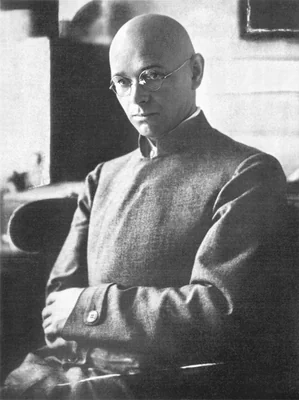
Johannes Itten (1888-1967) stands as one of the seminal figures in 20th-century artistic education, a Swiss Expressionist painter, designer, writer, and theorist whose rigorous pedagogical methods fundamentally shaped the landscape of modern art schooling. A co-founder of the State Bauhaus in Weimar, Itten formed the core contingent of the faculty alongside Walter Gropius, Lyonel Feininger, and Gerhard Marcks, helping to define the school’s early identity and ambition.
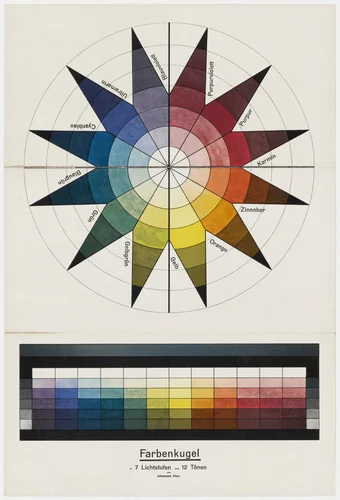
While his oil compositions reveal a distinctive Expressionist sensibility, Itten's most enduring legacy lies in his role as the Master of Form and the creator of the Vorkurs, or Preliminary Course. This required introductory curriculum broke from classical academic training, requiring students to rigorously investigate fundamental tenets of material structure, texture, color, and form. Itten championed a disciplined, analytical approach to perception, evidenced in influential theoretical diagrams such as the print Color Sphere in 7 Light Values and 12 Tones. His systematic approach to contrasting hues and tones became essential viewing for artists, students, and industrial designers alike, ensuring his theories remain a constant reference point in art education today. Many of his theoretical diagrams and early Johannes Itten prints are now widely available as downloadable artwork, providing essential study material.
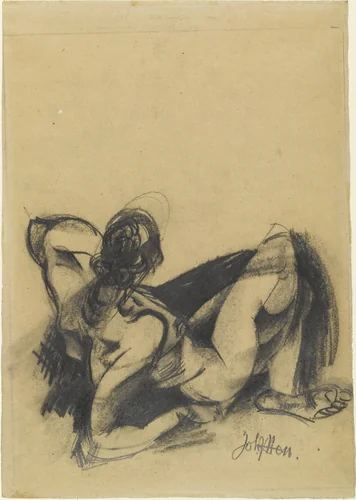
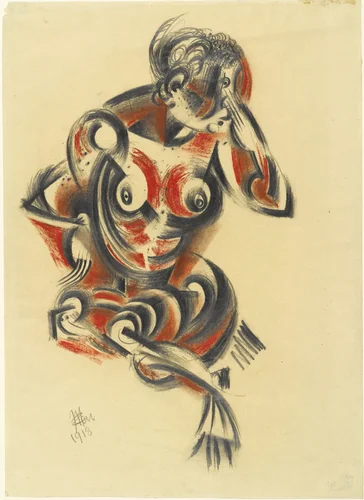
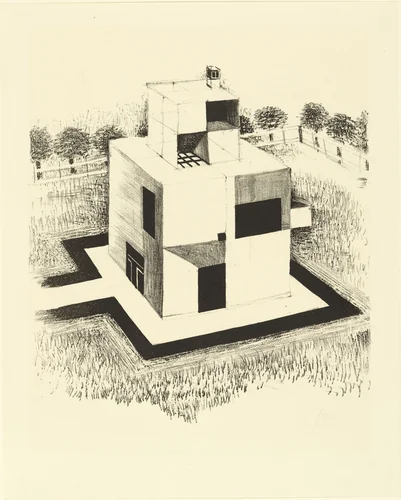
Itten’s own prolific output between 1917 and 1921 showcases his dynamic transition from pure Expressionism toward a more formalized visual language. His early work from this period, including the drawings Female Nude (Weiblicher Akt) and the sharply observed The Eavesdropper (Horchende), emphasizes spiritualized human forms and dramatic contrasts. His commitment to printmaking during his tenure at the Bauhaus is captured in his inclusion in the New European Graphics portfolio, with works like House of the White Man (Haus des weißen Mannes) positioning him firmly among the Masters of the Weimar period.
A defining characteristic of Itten’s tenure was the tension between his analytical pedagogical structure and his personal commitment to Mazdaznan, a philosophical movement emphasizing vegetarianism and spiritual purification. This unique blend of systematic methodology and esoteric spirituality resulted in an intense, disciplined classroom atmosphere. Itten’s seminal contributions to the Bauhaus were short-lived but highly impactful; the principles he established continue to resonate in contemporary design schools globally. Collected in institutions such as the Museum of Modern Art, his drawings, theories, and prints continue to inspire interest, with older works often falling into the public domain, making high-quality prints accessible worldwide.
Source: Wikipedia · CC BY-SA 4.0