Johanna Sibylla Küsel
Johanna Sibylla Küsel (sometimes recorded as Kraus) holds a specific, focused place within the history of 17th-century European printmaking. Active in 1646, she was based in Augsburg, then a central hub for German publishing and the meticulous production of reproductive engravings. Her reputation rests on a small but technically ambitious body of work, distinguished by precision and control in copperplate etching and engraving, demanding skills that were particularly prized in the Baroque era's commercial art market.
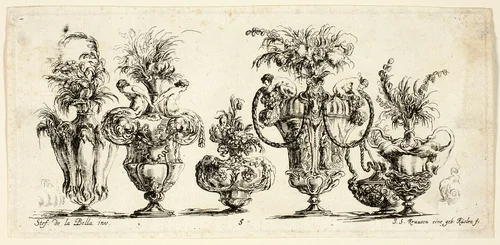
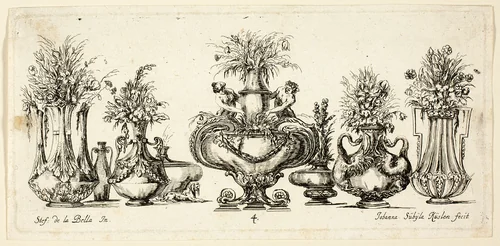
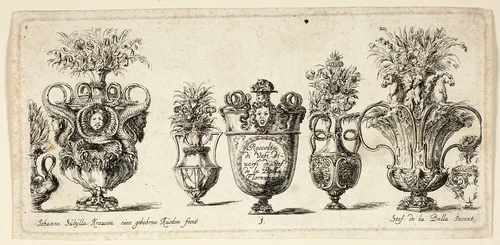
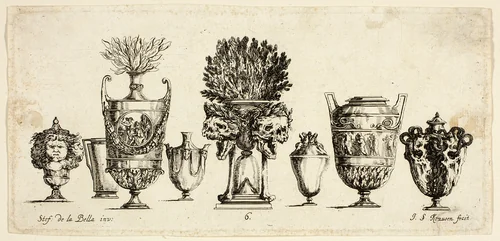
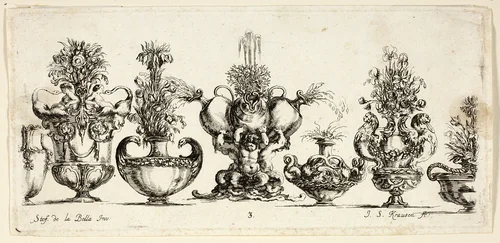
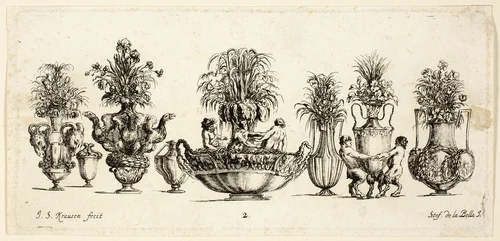
Küsel's known documented output comprises six key plates, all drawn from the series Raccolta di Vasi diversi di Stef. de la Bella Fiorentino. This undertaking was not an exercise in original composition but a rigorous demonstration of interpretive skill. She masterfully translated the whimsical, often complex, designs of the Florentine etcher Stefano della Bella. The plates, including Plate Three and Plate Six, illustrate ornamental vases rendered with delicate linear clarity, capturing the original’s inventive fusion of classical form and Mannerist flourish. In this period, the production of such high-quality prints served the vital function of circulating decorative designs and architectural motifs across continental Europe.
The scarcity of Küsel's recorded works—just six known plates—is unfortunately common among female artists whose professional activities were often confined to familial workshops or constrained by limited public exposure. That her name survives and is attached to such museum-quality pieces, despite the brevity of her documented career, speaks volumes about the enduring caliber of her technical execution. It is a quiet confirmation that precision sometimes outlasts prolific output.
Today, these intricate designs, held in collections such as the Art Institute of Chicago, are increasingly accessible. Through various cultural heritage initiatives, these historic images have moved into the public domain, meaning enthusiasts can easily find downloadable artwork. Ensuring that the legacy of Johanna Sibylla Küsel prints continues to reach modern audiences.
Source: Wikipedia · CC BY-SA 4.0