Johann Ulrich Kraus
Johann Ulrich Kraus (1637-1705) stands as a foundational figure in German printmaking, active for nearly seven decades as an illustrator, engraver, and publisher based in Augsburg. Operating during a critical era for the dissemination of visual culture, his prolific output documented everything from significant civic reconstruction projects to the elaborate, ephemeral performances of court opera and ballet. Kraus’s skill lay in transforming complex, large-scale events into clear, widely reproducible images, effectively bridging the gap between high culture and broader public accessibility.
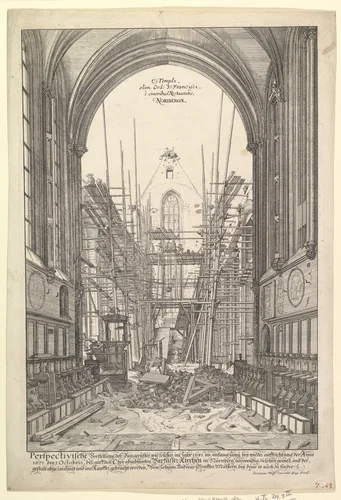
His professional focus often split between topographical clarity and dramatic narration. Prints from series such as the Views of Nuremberg function as invaluable historical records, providing precise visual evidence of 17th-century urban life and development. A work like View of the Church of the Franciscans in Nuremberg under Reconstruction details the exact state of architectural recovery, reflecting the pervasive influence of the Baroque desire for systematic documentation.
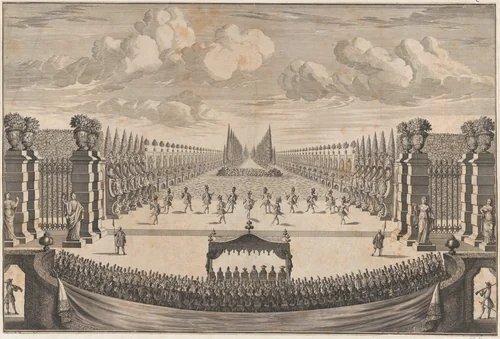
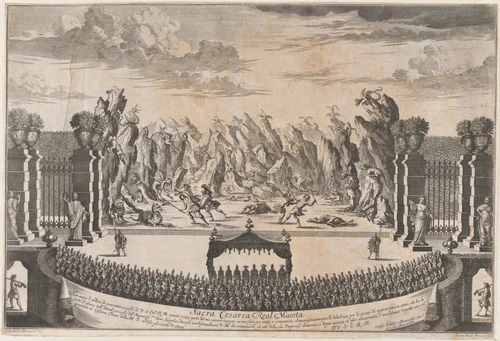
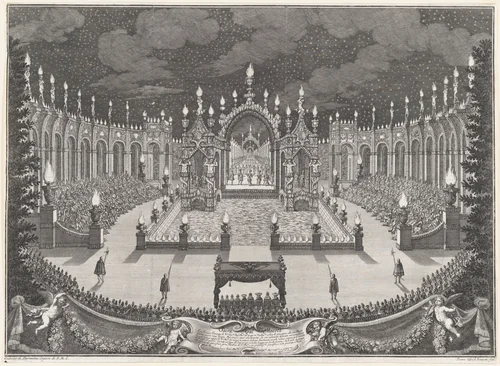
In sharp contrast to these architectural studies, Kraus became a specialist in capturing court spectacle. He documented commissioned theatrical performances, providing the permanent record of productions otherwise lost to time. His prints, including The royal family sitting under a canopy, watching dancers perform the opening ballet of 'La Costanza d'Ulisse' and the Final ballet of 'L'Euleo festeggiante nel ritorno d'Alessandro dall'India', capture the dazzling machinery, elaborate sets, and intricate choreography designed for elite audiences. It is subtly amusing, however, that while the energy of the dancers is captured in full swing, the royal family members, invariably seated under a magnificent canopy, often appear utterly static, presiding over the spectacle with a notable air of reserved observation.
Kraus’s work remains highly valued for its historical precision and artistic quality. Today, important examples of Johann Ulrich Kraus prints are held in major institutions, including the Metropolitan Museum of Art and the National Gallery of Art. Due to their age and historical importance, much of his documentation is now in the public domain, ensuring access to high-quality prints and downloadable artwork that preserve his rich visual legacy.
Source: Wikipedia · CC BY-SA 4.0