Johann Matthias Kager
Johann Matthias Kager (1566–1634) was a German historical painter whose extensive and active career, focused primarily between 1590 and 1620, bridged the stylistic demands of late Mannerist classicism with the emerging theatricality of the Baroque. Though based primarily in Southern Germany, the inclusion of several key drawings in the collections of the Metropolitan Museum of Art and the National Gallery of Art underscores his far-reaching significance within European draftsmanship.
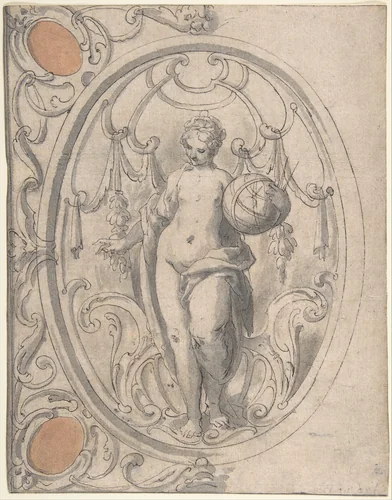
Kager excelled in compositions requiring complex figural arrangement and dense, highly detailed rendering. A significant portion of his surviving works consists of highly refined studies and preparatory designs, showcasing a painter who understood the necessity of precise planning before execution. His commitment to allegorical design is evident in works like the pen-and-ink study, Design for an Ornamental Panel with the Figure of Astronomy, which reveals a sophisticated mastery of the ornamental forms popular at the turn of the century.
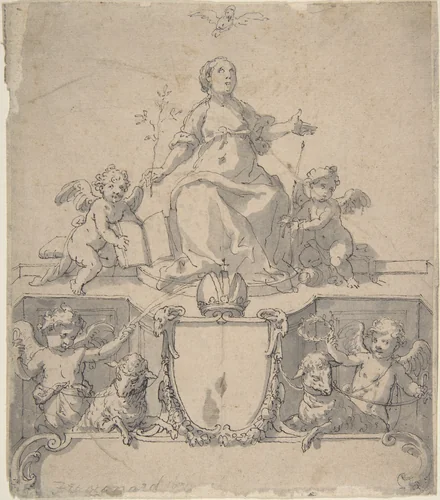
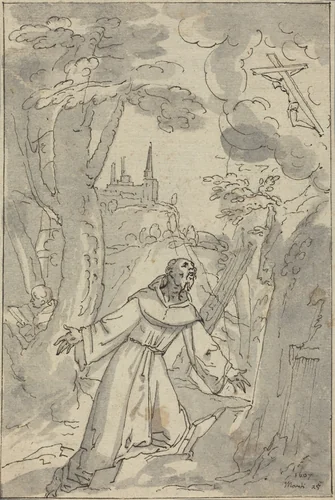
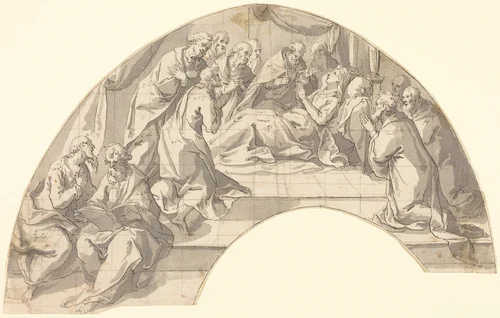
His thematic range extended seamlessly from pure design to powerful narrative. Within religious painting, Kager demonstrated the dramatic humanism appropriate for his time in pieces such as Death of the Virgin and the fervent spirituality depicted in The Stigmatization of Saint Francis. Simultaneously, works like Cartouche with a Crown, the Virgin (?) and the Holy Ghost, and Four Putti further cemented his reputation as a capable designer of ecclesiastical iconography, often serving as models for larger Johann Matthias Kager paintings or permanent frescoes.
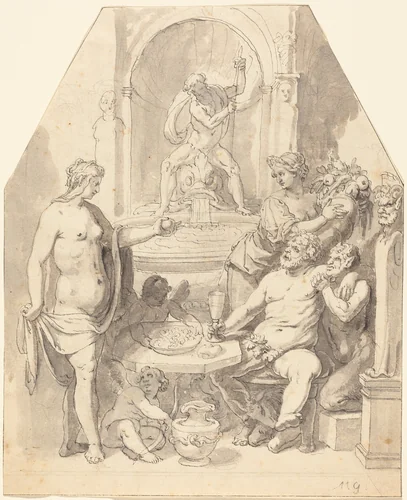
Perhaps his most elegant work is the mythological interpretation Without Ceres and Bacchus, Venus Freezes. This title, derived directly from Terence’s famous observation regarding the necessity of earthly sustenance for romantic vigor, suggests an artist who was not merely illustrating classical texts but engaging with literary wit. It is a subtle but clear indication of Kager's intellectual engagement. Today, the clarity and detail of his compositions make these drawings essential sources for historical study. The availability of his royalty-free artwork as high-quality prints ensures that the nuances of his precise draftsmanship continue to reach contemporary audiences far outside the original museum-quality collections.
Source: Wikipedia · CC BY-SA 4.0