Johann Hieronymus Kniphof
Johann Hieronymus Kniphof (1704–1763) occupies a significant but often overlooked position at the intersection of Enlightenment science and graphic art. Known primarily as a German physician and botanist, Kniphof’s lasting historical contribution resides not in taxonomy itself, but in his innovative approach to the visual documentation of flora during the mid-eighteenth century. His artistic output, active around 1757, provided crucial reproducible illustrations at a time when standardized scientific nomenclature, championed by Linnaeus, demanded unprecedented clarity and accuracy.
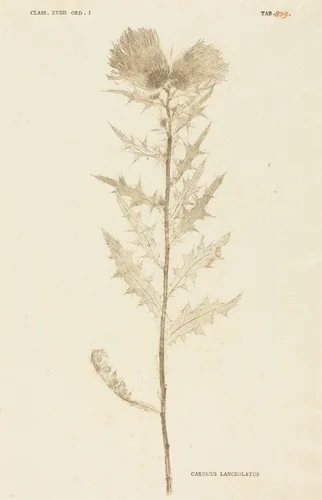
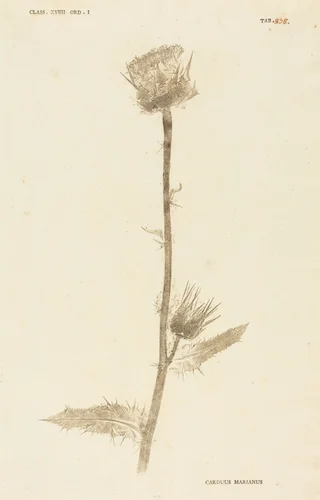
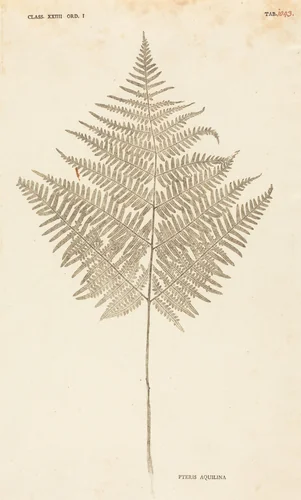
Kniphof’s work is characterized by the use of ‘nature printing,’ a pioneering method that moved beyond traditional line engraving. Instead of relying purely on the illustrator’s hand, Kniphof developed a process for making direct impressions of actual plant specimens onto prepared plates. This technique captured the subtle nuances of plant architecture and surface texture with a museum-quality fidelity previously unattainable. The results, as seen in meticulously rendered specimens like the thistle Carduus Lanceolatus and the fern Pteris Aquilina, exhibit a unique graphic quality, often appearing more three-dimensional and textural than hand-drawn counterparts.
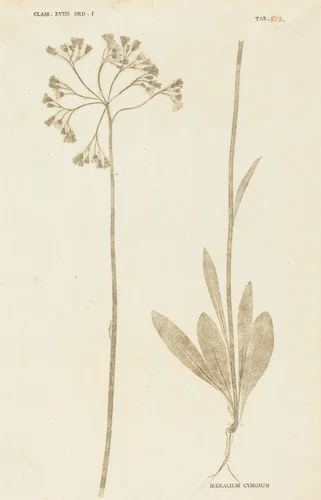
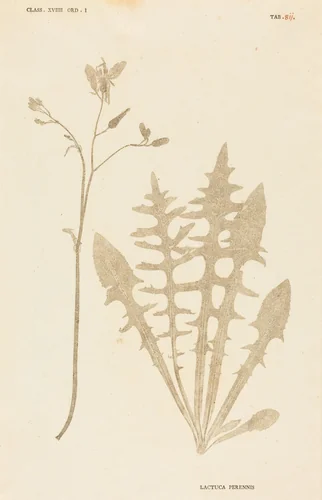
The relatively small corpus of Kniphof’s surviving prints, now held in major institutions such as the National Gallery of Art, serves as an invaluable catalogue of 18th-century European plants. Pieces such as Hieracium Cymosum and Lactuca Perennis demonstrate the powerful effectiveness of this method. It is notable that the nature printing process gives even the most common weeds a strangely monumental presence, treating every species with equal visual reverence. These highly detailed, high-quality prints served an essential educational and scientific function, aiding the dissemination of knowledge across Europe.
The importance of the Johann Hieronymus Kniphof prints transcends their botanical utility. His reliance on mechanical impression to achieve hyper-realism anticipated later reproductive technologies, effectively bridging the gap between artistic creation and mass scientific data dissemination. Because many of these historic illustrations are now in the public domain, they continue to be utilized by modern scholars, cementing Kniphof’s status as a technological innovator whose precise visual documentation remains relevant to both the history of science and the graphic arts.
Source: Wikipedia · CC BY-SA 4.0