Joaquín Torres-García
Joaquín Torres-García (1874-1949) stands as one of the most internationally significant Uruguayan-Spanish figures in 20th-century modernism, influential not just as a painter, but equally as a vital theorist and educator. Born in Montevideo, his artistic foundation was laid in Catalonia, Spain, initiating a career spanning vital cultural centers across Europe and the Americas, including the United States, France, Italy, and his native Uruguay. His sustained commitment to abstract principles and systematic approaches solidified his position among the avant-garde elite.
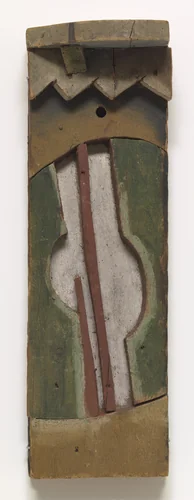
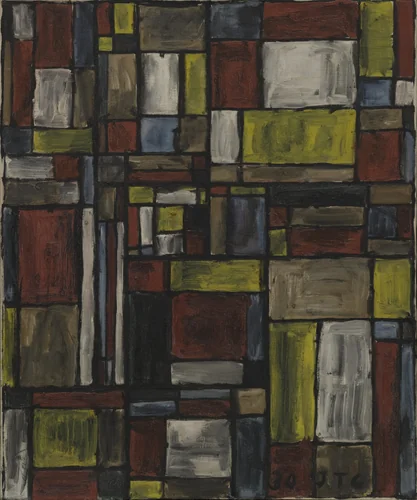
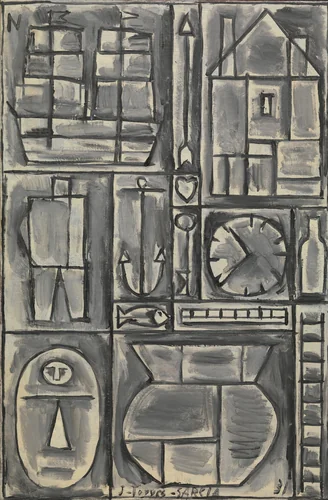
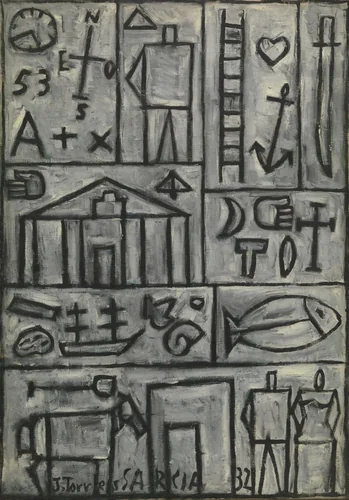
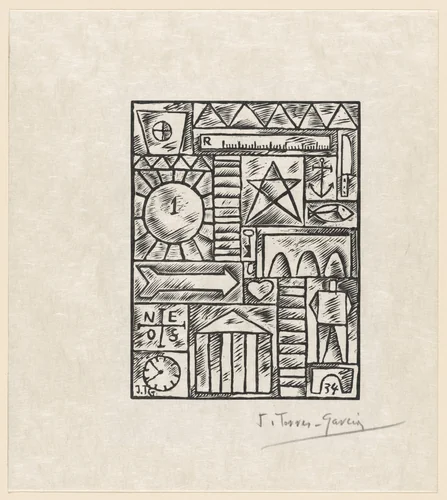
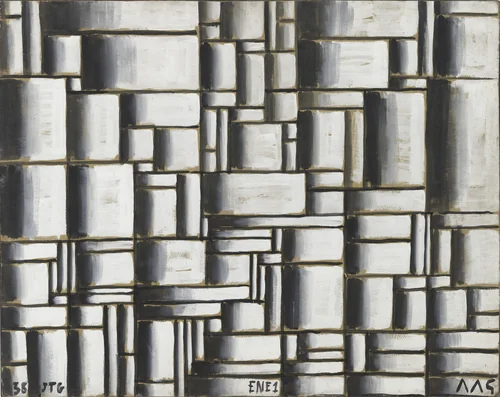
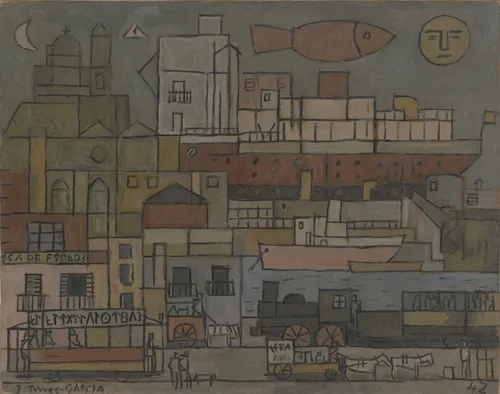
Torres-García’s career was marked by a relentless pursuit of synthesis, moving through phases he termed Modern Classicism and, most famously, Universal Constructivism. This philosophy was rooted in the belief that an inherent, shared human understanding of geometric structure existed, capable of bridging the ancient and the modern. His signature style integrates universal symbols, grids, and elemental forms—seen clearly in works such as Guitar and Composition—resulting in distinct, intellectually rigorous constructions.
His impact extended beyond his individual canvases. Torres-García possessed a profound organizational impulse, establishing influential art groups and educational initiatives that shaped the trajectory of global abstract art. In Paris, he co-founded Cercle et Carré, arguably the first definitive European abstract-art group, uniting figures like Piet Mondrian and Wassily Kandinsky under a common banner. Following this international triumph, he returned to Spain to establish Grupo de Arte Constructivo in Madrid, before ultimately launching the highly influential Taller Torres-García in Montevideo.
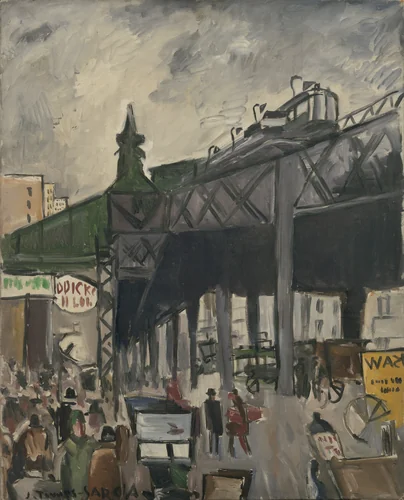
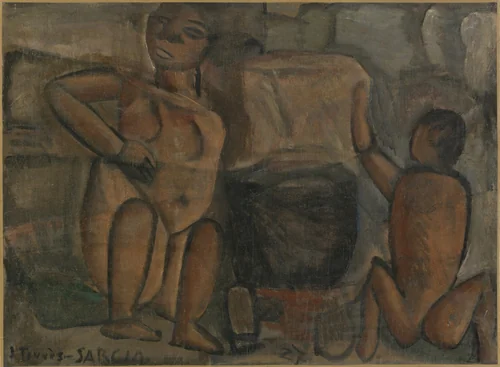
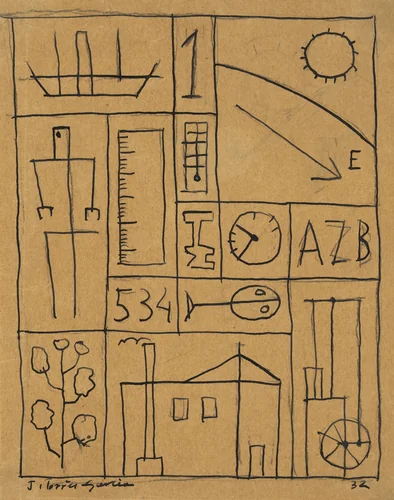
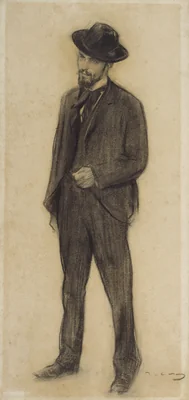
The collection of works associated with this prolific period, including paintings like Color Structure and the drawing Untitled (Figures), showcases the disciplined evolution of his constructivist vocabulary between 1920 and 1942. His relentless, almost bureaucratic dedication to structure is perhaps his most fascinating personal trait; he formalized chaos into order in every medium he touched, whether through a canvas, a drawing, or an illustrated book. Today, many important Joaquín Torres-García paintings are preserved in major international institutions, including the Museum of Modern Art. Scholars and enthusiasts frequently access high-quality prints of his work, now often available as royalty-free downloadable artwork, ensuring his foundational theories of Universal Constructivism continue to inform contemporary practice.
Source: Wikipedia · CC BY-SA 4.0