Joachim Beuckelaer
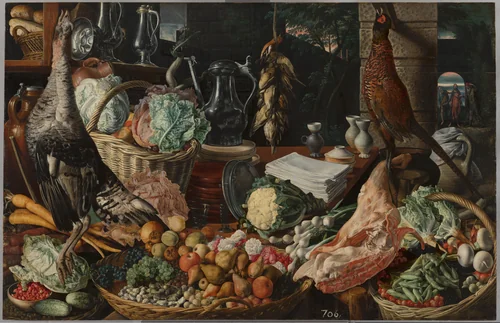
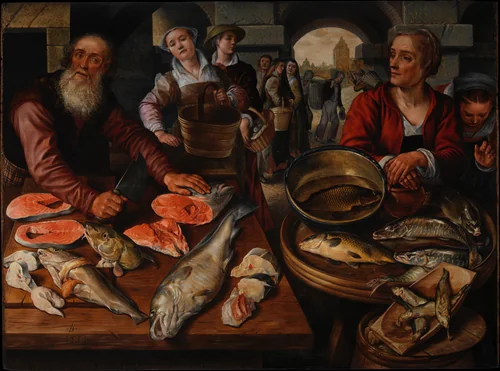
Joachim Beuckelaer (c. 1533-1568) stands as one of the most influential Flemish painters of the mid-sixteenth century, recognized for fundamentally transforming the conventions of secular visual culture. Active between 1533 and 1568, Beuckelaer specialized in elaborate market and kitchen scenes, compositions which shifted the focus of painting toward the everyday. His work is characterized by large, highly detailed displays of foodstuffs, prepared meats, and household equipment, rendered with startling realism and technical precision.
His innovation was pivotal for the history of art. By elevating the meticulous depiction of inanimate objects within the context of commerce and domesticity, Beuckelaer’s oeuvre proved immensely influential on the development of the still life genre throughout Northern Europe. This influence extended far beyond the Netherlands; his compositional principles were rapidly absorbed by major artistic centers in Italy and Spain, cementing his reputation as a key figure in the transition from genre painting to pure still life. Works such as Fish Market and Kitchen Scene with Christ at Emmaus exemplify his mastery in balancing vibrant figures with meticulously described material surroundings.
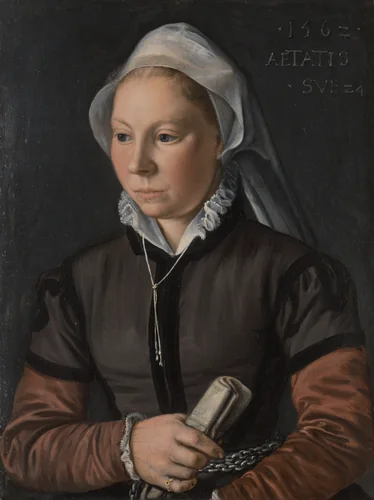
While celebrated for these expansive genre panels, Beuckelaer also produced pure still lifes that removed figures entirely, concentrating solely on the materiality of the objects themselves. Furthermore, he occasionally contributed the staffage, or figures and drapery, to the works of other prominent local painters, including Anthonis Mor, a testament to the high regard held for his figurative skills. The enduring popularity of his large-scale scenes ensures that high-quality prints of Joachim Beuckelaer paintings remain important resources for art historians studying 16th-century Mannerism.
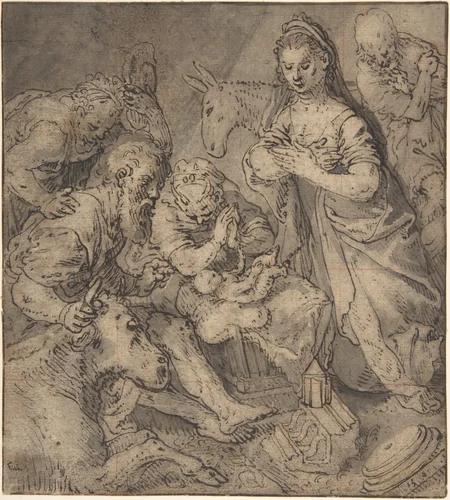
Beuckelaer often utilized the visual device of embedding a small religious narrative in the background of a bustling foreground, such as the distant biblical scene layered into Kitchen Scene with Christ at Emmaus. This sophisticated technique invited the viewer to contemplate spiritual matters while simultaneously being confronted by an overwhelming material abundance. One might observe that the sheer volume of produce depicted in his markets often seems to exceed the realistic capacity of contemporary trade, suggesting these compositions function as studies in domestic opulence as much as realistic portrayals of commerce. Today, his canvases and drawings, including Adoration of the Shepherds, are preserved in global institutions, making museum-quality reproduction available for scholarly and public access.
Source: Wikipedia · CC BY-SA 4.0