Jean Restout
The name Jean Restout designates not a single master, but a remarkably potent artistic dynasty that spanned three generations of French Academic painting. This lineage, which was anchored firmly in the rigorous classical traditions of the Académie Royale, comprises Jean I (1666–1702), his celebrated son Jean II (1692–1768), and the final inheritor of the style, Jean-Bernard (1732–1797). Collectively, the Restouts dominated commissions for historical and religious subjects in Paris throughout the first half of the eighteenth century.
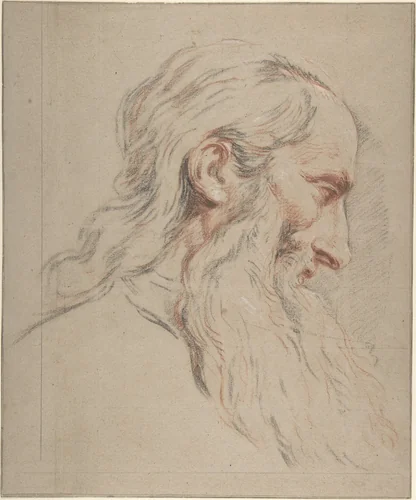
Jean II Restout, the most prominent and prolific figure, defined the family’s mature style during their most active period. He was celebrated for his serious, carefully constructed compositions designed for monumental church and civic settings. Unlike the lighter, more frivolous tendencies emerging concurrently in Parisian salons, Restout’s adherence to gravitas cemented his position within the formal academic establishment. His surviving output demonstrates a powerful commitment to precise draftsmanship, an essential skill for his large-scale canvases.
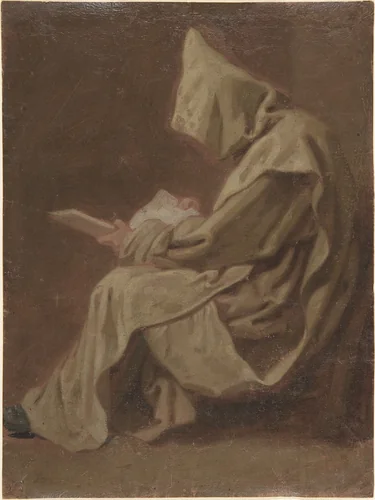
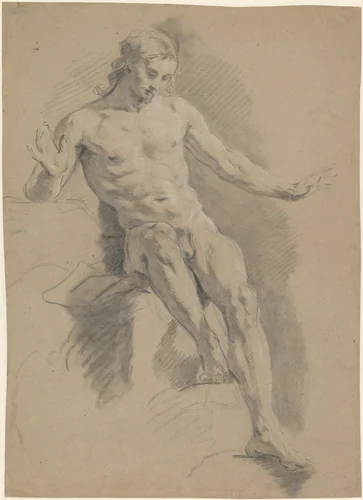
The careful academic preparation underpinning his success is evident in studies held today in international collections, including the Metropolitan Museum of Art and the Art Institute of Chicago. These preparatory works, such as the finely observed Seated Carthusian Holding an Open Book and the formal anatomical study Seated Male Nude, showcase a masterful command over human form and drapery. The artist often exhibits a curious tension in his work: a devotion to the piety and gravity of traditional subject matter, yet rendered with the softening light and elegant precision that would soon define the transition into the Rococo era.
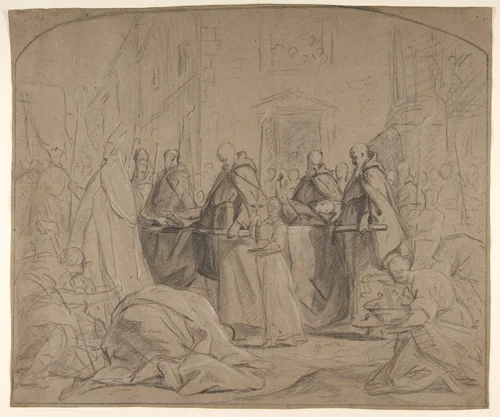
Restout’s detailed historical renderings, including the evocative sketch for the Funeral of François Duplessis de Mornay, remain critical records of early 18th century French technique and history painting. His legacy includes a substantial body of museum-quality artwork that set the standard for academic rigor. As many of these classical works and Jean Restout prints have since entered the public domain, they are increasingly accessible to scholars and students globally, ensuring that high-quality prints continue to allow contemporary audiences to appreciate the meticulous command of this influential family of artists.
Source: Wikipedia · CC BY-SA 4.0