Jean Pougny
Jean Pougny, born Ivan Albertovich Puni, occupies a compelling, yet complex, position within early twentieth-century modernism, bridging the explosive experimentation of the Russian Avant-Garde with the nuanced pictorial concerns of Parisian post-impressionism. His artistic trajectory was defined less by strict adherence to a single school than by an intensive, almost restless, engagement with evolving visual languages across his career.
Pougny’s most defining characteristic was his capacity for stylistic reinvention. Unlike many of his contemporaries who aggressively solidified a signature visual mandate, Pougny moved dynamically through various aesthetic modes before settling in the direction of lyric Primitivism. This final stylistic evolution, favoring intimate observation and soft, poetic figuration reminiscent of artists like Pierre Bonnard and Édouard Vuillard, demonstrated a deliberate withdrawal from radical structuralism. It is perhaps characteristic of his mercurial approach that he often appeared to change his artistic viewpoint along with his name.
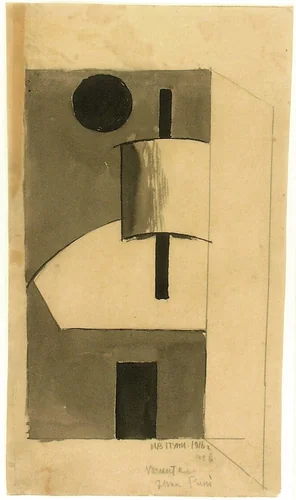
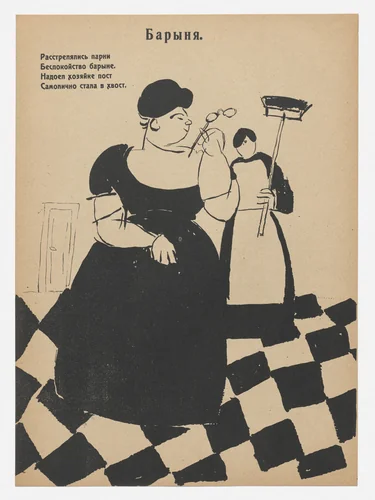
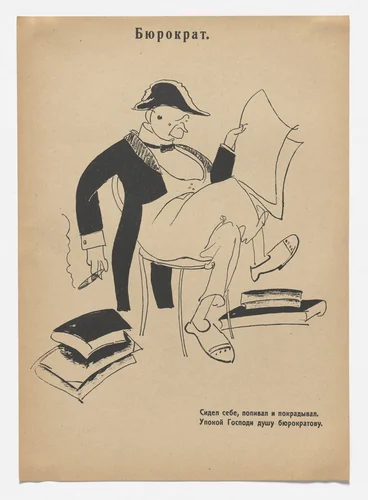
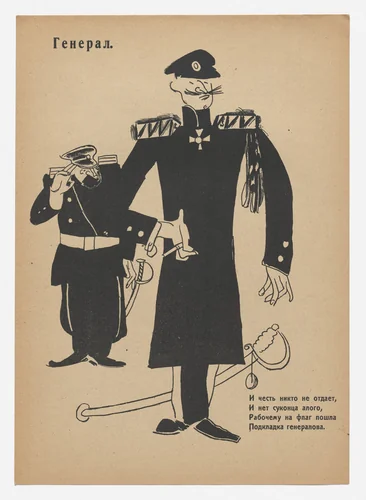
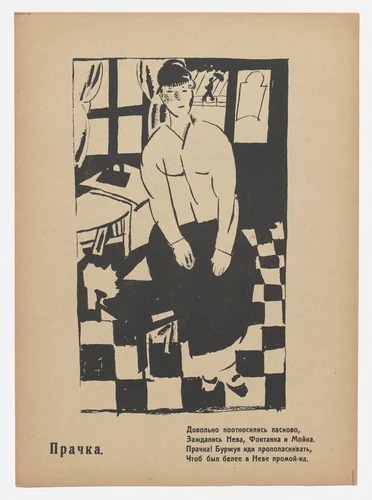
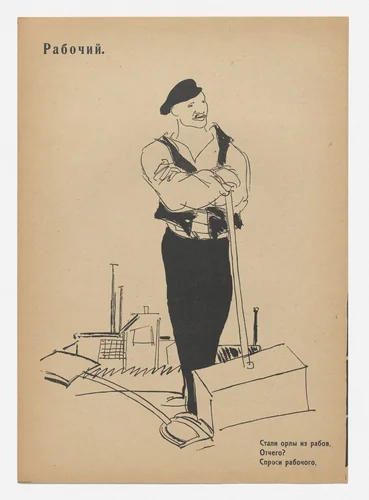
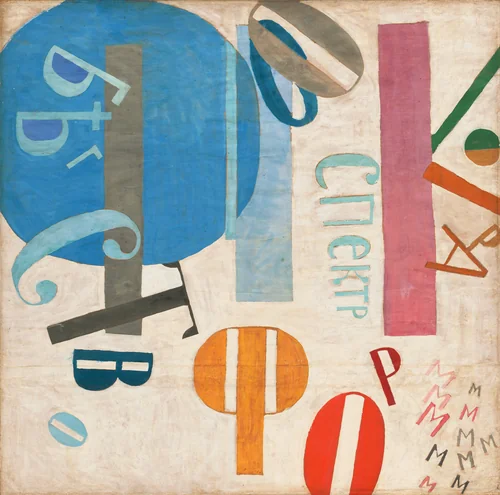
The relatively brief, intense period between 1916 and 1919 produced some of his most historically resonant graphic work. During this time, he executed conceptual pieces such as the Study for Relief Sculpture alongside a focused series of prints reflecting the tumultuous environment of the Russian Revolution. His portfolio Geroi i zhertvy revoliutsii. Oktiabr' 1917–1918 (Heroes and Victims of the Revolution) offers sharp character studies, capturing societal archetypes in the immediate aftermath of political upheaval. The collection presents figures ranging from the powerful, like Barynia (Landowner's Wife) and General, to the mundane and necessary, exemplified by the Prachka (Laundress) and the stiff officialdom of the Biurokrat (Bureaucrat).
Although Pougny’s later career unfolded primarily in France, this earlier Russian period cemented his critical importance as an observer of seismic cultural change. His early drawings and high-quality Jean Pougny prints are held in significant public institutions, including the Museum of Modern Art. Today, many of these historical works are in the public domain, allowing for their reproduction as downloadable artwork for scholarly study and public appreciation.
Source: Wikipedia · CC BY-SA 4.0