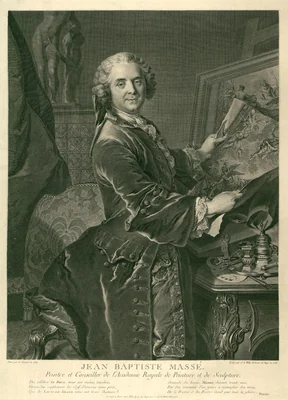
Jean-Baptiste Massé
Jean-Baptiste Massé was an artist active across the first half of the eighteenth century, with documented production spanning the period between 1707 and 1752. His extant work indicates a primary focus on printmaking, encompassing both portraiture and highly detailed architectural and decorative studies.
The five works by Massé documented in museum collections demonstrate a diverse set of subjects. He produced intimate portraits, such as Pierre Louis Dubus (1721-1799), Called Préville, of the Comédie-Française, alongside specialized engravings detailing royal interiors. His architectural studies often focused on the elaborate decorative elements of Versailles, including precise documentation of specific ceiling and arch details within major halls, exemplified by L'Allemagne Cintre du Salon de la Guerre du côté des appartemens du Roi and La Hollande Cintre du Salon de la Paix en face des Appartmens de la Reine. Another work, Protection accordée aux beaux-arts 1663, reflects an engagement with historical subjects concerning state patronage of the arts.
The Metropolitan Museum of Art and the National Gallery of Art hold works by Jean-Baptiste Massé, confirming his representation in significant American collections. As historical documents and important examples of French engraving, many of these Jean-Baptiste Massé prints are now in the public domain, allowing for the reproduction of high-quality prints for scholarly research.
![L'Allemagne Cintre du Salon de la Guerre du côté des appartemens du Roi (Germany, Center of the Salon of War next to the King's Chambers) [pl. 37] by Jean-Baptiste Massé, print, 1752](https://img.artbee.org/44d36d0f-4cf0-4789-a49c-c63f052b1733/small.webp)
![La Hollande Cintre du Salon de la Guerre sur L'Arcade qui donne entrée dans la Galerie (Holland, Center of the Salon of War in the Arcade that Opens into the Gallery) [pl. 39] by Jean-Baptiste Massé, print, 1752](https://img.artbee.org/3d204a20-0d1a-478b-84ed-2ad11e85c64f/small.webp)
![La Hollande Cintre du Salon de la Paix en face des Appartmens de la Reine (Holland, Center of the Salon of Peace Opposite the Queen's Apartments) [pl. 48] by Jean-Baptiste Massé, print, 1752](https://img.artbee.org/9a5f23c4-44d0-4771-83ab-50023f44e590/small.webp)
![Protection accordée aux beaux-arts 1663 (Protection Granted to the Fine Arts 1663) [pl. 24] by Jean-Baptiste Massé, print, 1752](https://img.artbee.org/a4cc623d-6023-4cec-8cdc-296717580218/small.webp)