Jean Baptiste Jouvenet
Jean-Baptiste Jouvenet (1644-1698) stands as a foundational figure in French academic painting of the late seventeenth century, celebrated almost exclusively for his profound dedication to religious subjects. Operating during a period dominated by the tastes and doctrines of the Royal Academy, Jouvenet specialized in large-scale altarpieces and narrative cycles that successfully translated sacred stories into dynamic, emotionally resonant compositions suitable for grand public display.
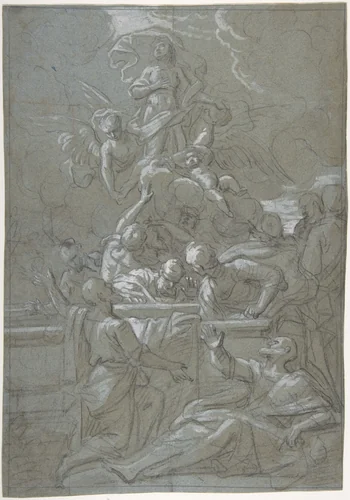
His training and subsequent career trajectory placed him in direct competition with masters of the period, yet Jouvenet distinguished himself through a uniquely energized style. Where others favored rigid classicism, Jouvenet introduced a dramatic flair, utilizing powerful diagonals, expressive gestures, and a masterful handling of light and shadow to heighten the spiritual intensity of his scenes. Preparatory works, now held in major international institutions, provide crucial insight into this meticulous process. Drawings such as St. Peter Healing the Sick with His Shadow (Acts 5:15-16) demonstrate his rigorous attention to anatomical precision and monumental grouping, techniques necessary for executing commissions of such historical gravity.
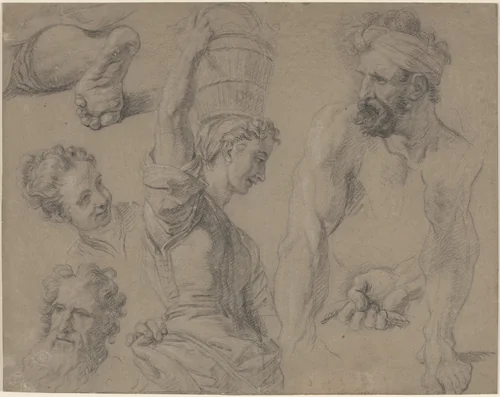
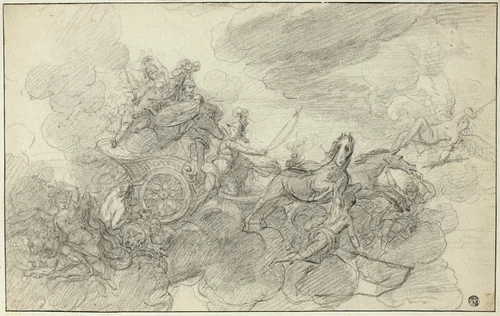
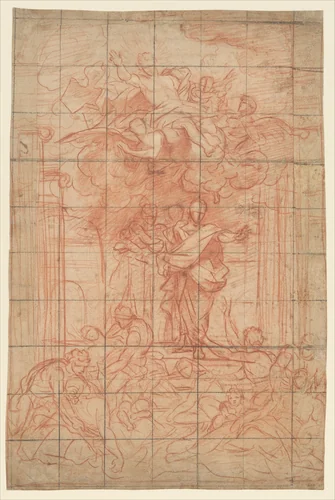
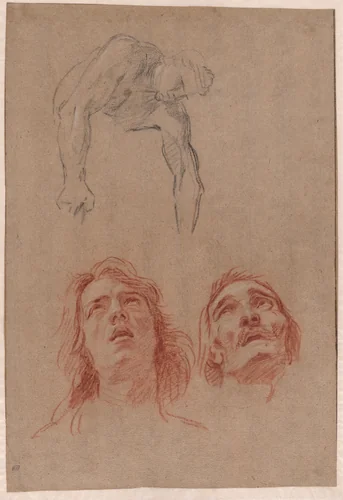
The surviving corpus of his draftsmanship, housed in esteemed collections including the Metropolitan Museum of Art, the National Gallery of Art, and the Art Institute of Chicago, often reveals the sheer scope of his planning. Detailed compositional studies like Study for Miraculous Draught of Fishes (?) confirm his command over spatial relationships, while rapid-fire figure sketches, such as Man Reaching Down and Two Studies of Heads (recto), underscore his dexterity. Jouvenet was particularly noted by contemporaries for the speed and efficiency of his output, a necessary attribute given the demand for Jean Baptiste Jouvenet paintings in Parisian churches. His ability to render the turbulent folds of drapery, making his figures appear caught in a divine wind, became a subtle stylistic signature that imbued his canvases with a sense of perpetual motion.
Although many of his most significant altarpieces remain in situ in France, these preparatory drawings are often found in the public domain. This accessibility allows for comprehensive study of his development, providing a clear record of the Baroque synthesis he achieved between narrative clarity and theatrical grandeur. Enthusiasts and researchers can easily find high-quality prints and downloadable artwork derived from these museum-quality preparatory sheets, confirming Jouvenet’s enduring legacy as a central proponent of classical French sacred art.
Source: Wikipedia · CC BY-SA 4.0