- National Gallery, London.jpg)
Jan van Eyck
Jan van Eyck (c. 1390-1441) stands as a monumental figure of the Early Northern Renaissance, whose technical innovations in the oil medium fundamentally shifted the trajectory of European painting. Working primarily from his base in Bruges, this Flemish master was the supreme figure and early innovator of what swiftly became known as Early Netherlandish painting.
Van Eyck’s legacy is often encapsulated by the famous 16th-century claim made by Giorgio Vasari, labeling him the “inventor of oil painting.” While historical scholarship recognizes this as a romantic oversimplification, Van Eyck was undeniably the individual who perfected and popularized the medium. He developed complex layering, meticulous glazing, and novel varnish techniques, which allowed for an unprecedented richness of color, intense luminosity, and astonishing visual depth that had not previously been achievable in tempera. His surfaces possess a jewel-like intensity that was revolutionary for the time.
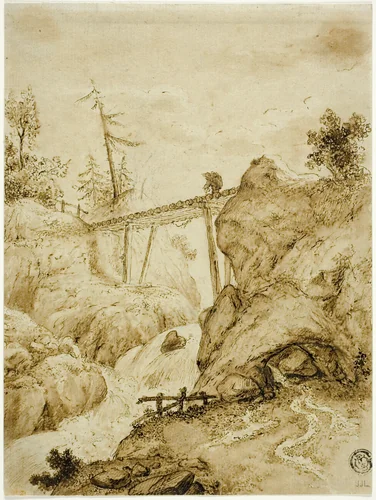
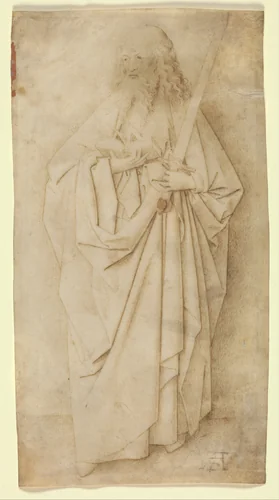
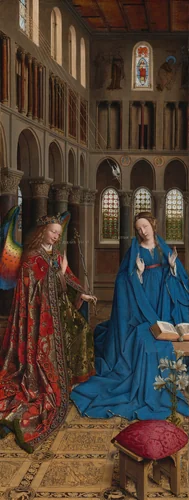
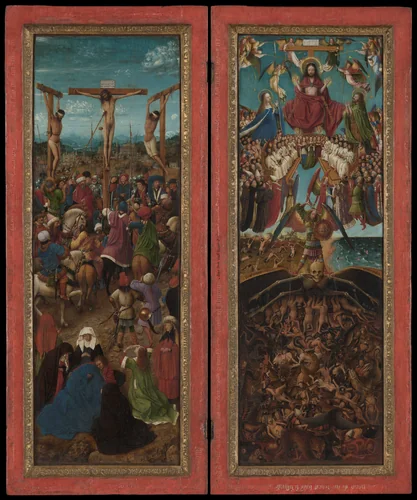
His style is characterized by hyper-realistic observation and the incorporation of subtle, often disguised, symbolism. This meticulous attention to texture, light, and form is evident in major surviving compositions, such as The Annunciation and the powerful diptych The Crucifixion; The Last Judgment. Even in smaller, focused studies, like Saint Paul or the specific atmospheric detail of Man Crossing Log Bridge over Torrent, Van Eyck’s command of the optical effects of light upon various surfaces-from fabric and fur to reflective metal-is nearly unmatched in the 15th century. These early Jan van Eyck paintings set the benchmark for detailed realism that would influence generations of artists across the continent.
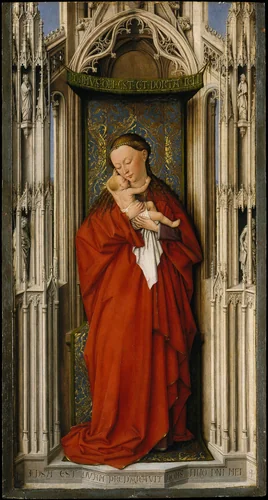
Intriguingly, despite the artist’s fame and influence, the body of work definitively attributed to him remains remarkably small, suggesting a highly selective or perhaps incredibly time-consuming artistic process. Today, collectors and enthusiasts seeking high-quality prints of celebrated works, such as Virgin and Child in a Niche, benefit from the increasing availability of downloadable artwork from major institutions like the National Gallery of Art and the Metropolitan Museum of Art, whose vast holdings are now frequently in the public domain.
Source: Wikipedia · CC BY-SA 4.0