Jan van Almeloveen
Jan van Almeloveen (active circa 1662) holds a distinct, if specialized, place among 17th-century Dutch graphic artists. Primarily known as an engraver and draughtsman, his surviving oeuvre, consisting of precisely fourteen recorded prints and a single drawing, offers an important topographical record of the period. His brief but focused working period yielded a series of influential landscape etchings characterized by exceptional technical refinement. Collections such as the Rijksmuseum maintain this limited but valuable output, which serves as a window into the specificity of mid-seventeenth-century Dutch life.
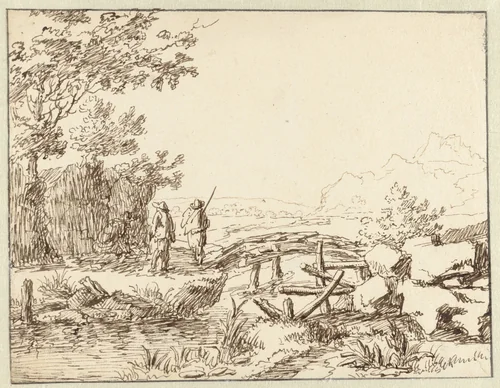
Almeloveen specialized in the meticulous rendering of the Dutch countryside, demonstrating the period's commitment to recording local geography with almost cartographic precision. He excelled in the medium of etching, utilizing the precision of the etcher’s needle to capture the intimate scale of rural life. Unlike many contemporaries who focused on dramatic, idealized vistas, Almeloveen concentrated on specific locales, often along the rivers Lek and Merwede. Titles such as Gezicht op Groot-Ammers, Gezicht op Jaarsveld, and Gezicht op Streefkerk underscore this dedication to verifiable local specificity.
These works are valued not only for their high-quality technique, which historical accounts recognized as "neatly executed," but also for their status as historically verifiable documents. His landscape etching, Herfst, a particularly refined example of his skill, illustrates the changing light and texture of the seasons, elevating simple topographic studies to nuanced artistic statements. His approach suggests that even the quietest corners of the Netherlands deserved museum-quality attention.
The limited extent of Van Almeloveen's documented activity, seemingly spanning just a single year, raises persistent curatorial questions regarding whether his career was curtailed prematurely or if his activity was simply focused elsewhere, perhaps in ephemeral projects now lost to time. Despite the rarity of original Jan van Almeloveen prints, their legacy is often preserved through high-resolution reproductions. Today, scholars and enthusiasts benefit from the availability of much of his collection in the public domain, allowing detailed study of 17th-century Dutch topographical art far beyond traditional print room access.
Source: Wikipedia · CC BY-SA 4.0