Jan Gossaert
Jan Gossaert, known often as Jan Mabuse, was a pivotal French-speaking painter hailing from the Low Countries whose career fundamentally bridged the late Netherlandish style and the high idealism of the Italian Renaissance. Matriculating into the Guild of Saint Luke in Antwerp in 1503 as Jennyn van Hennegouwe, Gossaert quickly established himself, but his historical significance rests primarily on his pioneering travel south.
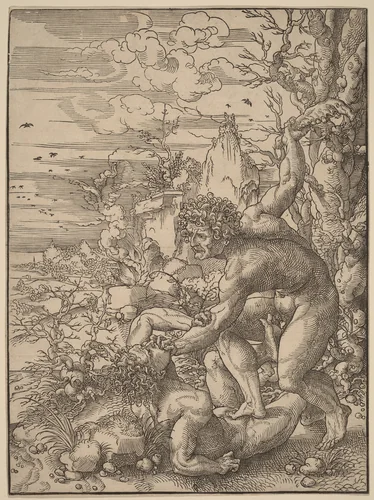
Around 1508-1509, Gossaert journeyed to Rome. This exposure to classical antiquity and the monumental achievements of contemporary Italian masters permanently redefined his approach to form, structure, and scale. Upon his return to the North, he became a leading figure in the style known as Romanism, an approach characterized by the robust adoption of Italianate elements: nude figures rendered with classical musculature, complex architectural ruins, and contrapposto poses.
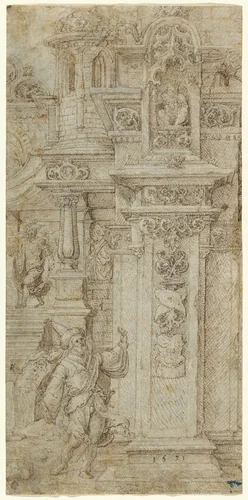
While this hybridization sometimes resulted in striking and occasionally idiosyncratic combinations of Flemish surface detail and Mediterranean monumentality—the former often applied to the latter—Gossaert’s work proved hugely influential. His output spanned religious subjects, large altarpieces, and mythological scenes. This dramatic tension between detailed Northern rendering and Italian structural mass is evident in complex narrative compositions such as Two Kings and a Woman Leaving an Elaborate Palace.
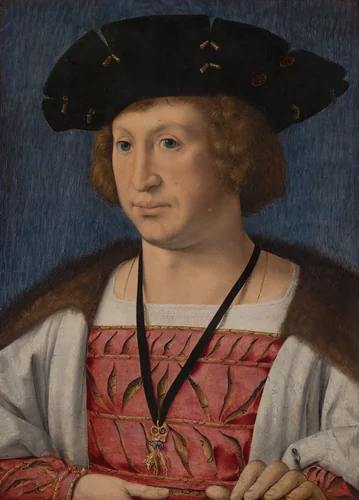
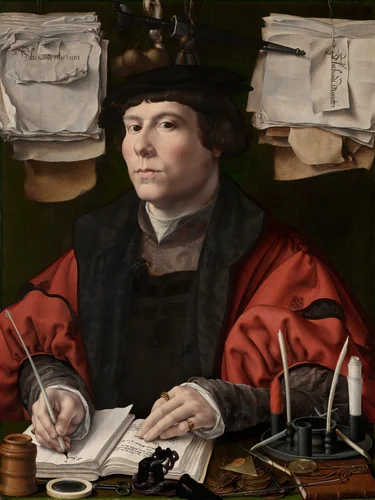
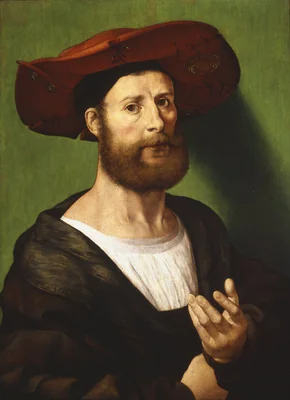
Equally adept at focused observation, Gossaert produced a series of penetrating portraits that solidified his fame across northern Europe, exemplified by the masterful Portrait of Floris van Egmond (1469-1539). He also undertook major devotional commissions, including the intricate diptych Saint Jerome Penitent, which showcases both his command of landscape and his sensitivity to human form.
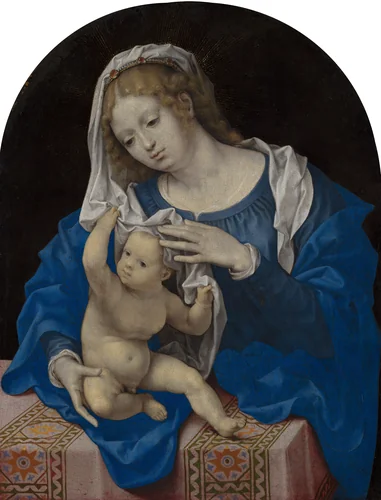
The widespread appreciation of his work is confirmed by the international placement of major Jan Gossaert paintings in collections such as the Mauritshuis and the National Gallery of Art. For scholars and collectors alike, surviving records and available high-quality prints of Gossaert’s corpus confirm his indispensable role in forging the visual language of the Northern Renaissance.
Source: Wikipedia · CC BY-SA 4.0
![Saint Jerome Penitent [left panel] by Jan Gossaert, painting, 1509-1512](https://img.artbee.org/381cd811-10e5-4e1d-9dea-9f0277a6c681/small.webp)
![Saint Jerome Penitent [right panel] by Jan Gossaert, painting, 1509-1512](https://img.artbee.org/3edc24f2-2131-4a5a-b7fa-c853ee594801/small.webp)