Jan de Baen
Jan de Baen holds a significant position within Dutch Golden Age portraiture, known particularly for his penetrating depictions of the era's political and military elite. Born in the mid-seventeenth century, his foundational training established him firmly within the Amsterdam school; he studied under the highly regarded Jacob Adriaensz Backer from 1645 to 1648. This formative period equipped him with the technical skill necessary to render the nuances of luxurious fabrics and the delicate balance required to convey high societal status, abilities he would soon employ for the most powerful figures in the Netherlands.
De Baen’s career trajectory benefited immensely from his connections to prominent political figures and expatriate royalty. Early in his professional life, he secured the patronage of Charles II of England during the latter’s period of Dutch exile. This appointment affirmed his standing among the privileged class. Following the Restoration, De Baen relocated permanently to The Hague around 1660, establishing his studio in the epicenter of Dutch political power, where he remained active until his death. This strategic placement ensured a steady stream of high-profile commissions from the stadtholder's court and the influential merchant regents. His portraits were highly popular and frequently celebrated in their day, making De Baen one of the era's premier visual chroniclers.
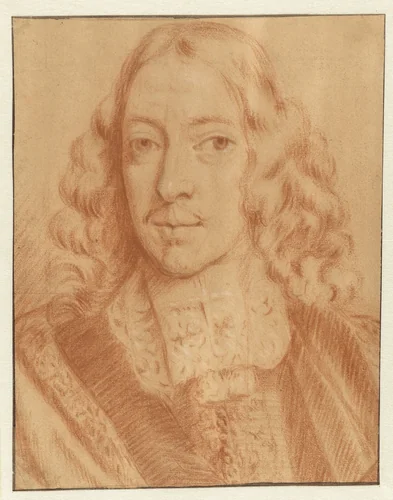
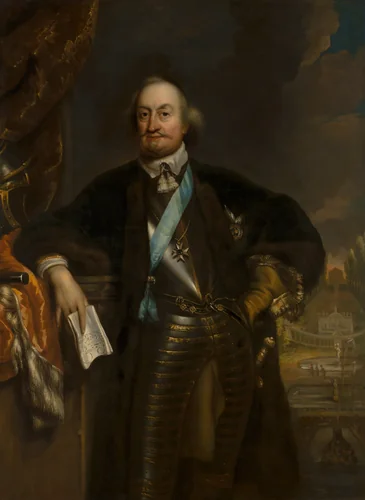
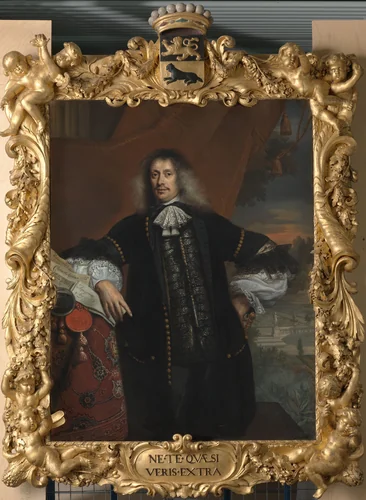
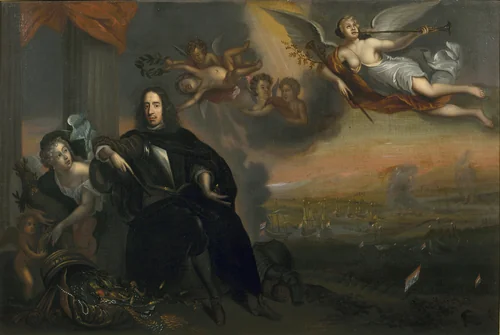
The core of De Baen’s oeuvre resides in these formal likenesses, many of which now form the basis of our understanding of late seventeenth-century Dutch political history. Among his most compelling works are the official depiction of Portrait of Johan Maurits (1604-1679), Count of Nassau-Siegen, the founder of the Mauritshuis, and the powerful series concerning Cornelis de Witt. The depiction of the influential statesman is often paired with the dramatically insightful Allegory of Cornelis de Witt (1623-1672) as Instigator of the Victory at Chatham in 1667. One might note, however, that De Baen exhibited a remarkable talent for professional detachment, creating equally definitive portraits for figures on opposing sides of the complex political conflicts of the time, including Portret van Cornelis de Witt and his ally, Hieronymus van Beverningk.
These essential Jan de Baen paintings, valued for their historical and artistic merit, are frequently sought after as museum-quality reproductions, with many of his works falling into the public domain. This accessibility allows institutions and enthusiasts to obtain downloadable artwork and high-quality prints of his distinguished subjects. De Baen’s surviving output, conserved in major institutional holdings such as the Mauritshuis and the Rijksmuseum, continues to serve as a vital record of seventeenth-century Dutch influence.
Source: Wikipedia · CC BY-SA 4.0