James Seymour
James Seymour (1702–1752) was a notable English artist of the early eighteenth century, recognized primarily for his masterful contributions to sporting and equestrian portraiture. Active between 1702 and 1748, his relatively compact output captures the elegance and intensity of aristocratic pursuits in Britain, securing his place in prestigious institutions today, including the Metropolitan Museum of Art, the National Gallery of Art, and the Art Institute of Chicago.
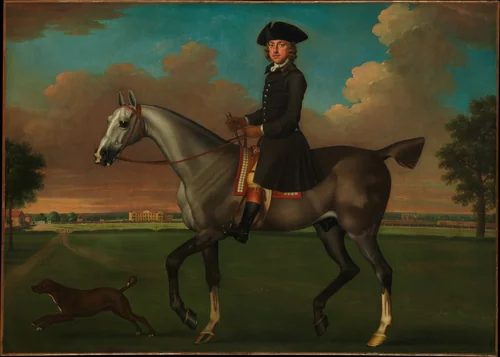
Seymour flourished during a period when the horse was central to military, social, and cultural life. Unlike some of his contemporaries who focused purely on static anatomical studies, Seymour specialized in conveying the drama of the hunt. His surviving oeuvre showcases a refined technique in both oil and graphite, demonstrating his ability to render both detailed formal portraits and swift, kinetic studies. While represented by the singular known oil Portrait of a Horseman, the majority of his accessible catalog consists of high-quality preparatory drawings and sketches.
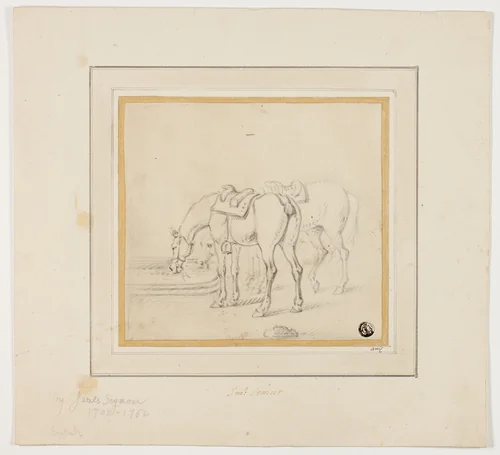
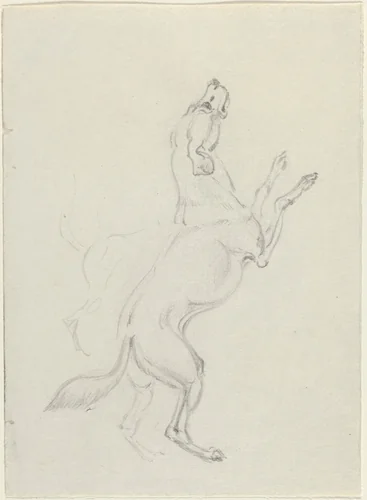
These sketches, such as Huntsmen with Hounds and a Crouching Hare and the focused study A Hound Jumping, reveal a quick, confident hand adept at capturing animals in rapid motion. The dual nature of his drawing practice is exemplified by works like Mounted Horsemen [verso], suggesting his artistic method was deeply rooted in immediate observation before formal execution. It is telling that even his study Two Horses Drinking emphasizes interaction and musculature rather than stiff formality, hinting at an artist who perhaps appreciated the lively competition of the chase as much as the quiet study of form.
Seymour’s meticulous documentation of early 18th-century equestrian life makes his surviving works invaluable historical documents and museum-quality examples of the genre. As many significant drawings and James Seymour prints are entering the public domain, researchers and collectors are gaining fresh access to the technical brilliance of this quintessential English artist, reinforcing his enduring appeal centuries later.
Source: Wikipedia · CC BY-SA 4.0
![Huntsmen with Hounds and a Crouching Hare [recto] by James Seymour, drawing, 1702-1752](https://img.artbee.org/d92c0cae-e6a6-4f56-83b6-abc38336405f/small.webp)
![Mounted Horsemen [verso] by James Seymour, drawing, 1702-1752](https://img.artbee.org/00f502e1-f25b-4516-8223-8fa4ff80915a/small.webp)