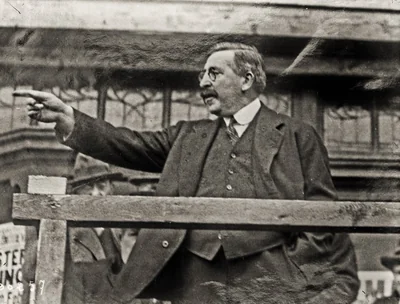
James O'Mara
James O'Mara (1873-1948) occupies a singular position in the history of modern Irish state formation, transitioning seamlessly, if dramatically, from the established machinery of the British Parliament to the revolutionary leadership of the nascent Dáil Éireann. His career provides an essential study in political adaptability and enduring commitment to constitutional structure.
O’Mara first established his reputation through decisive legislative action. While serving as a Member of Parliament in the House of Commons of the United Kingdom, O'Mara championed and introduced the landmark bill that formally designated Saint Patrick's Day as a national holiday in Ireland in 1903. This act of cultural codification, arguably one of the most successful legislative ‘designs’ ever executed by a politician, remains his most widely recognized public domain legacy, confirming the cultural import he placed on formalized national identity. The subsequent requirement that pubs close briefly on the day, a measure aimed at ensuring the holiday was observed with appropriate solemnity, adds a wry, human dimension to his institutional vision.
This initial period of political contribution gave way to O'Mara's defining revolutionary role. Recognizing the necessity of self-governance, he became a vital nationalist leader and a key member of the revolutionary First Dáil, where he contributed to structuring the administrative foundation of the emerging state. His involvement was crucial in defining the transfer of institutional authority during a period of profound national redefinition.
O'Mara is distinctive for his unparalleled service, being one of the few figures in Irish political history to have held membership in both the House of Commons and, subsequently, in Dáil Éireann. This duality underscores the depth of his commitment to representative structure, regardless of the institutional frame. His foundational work continues to inform the study of political science and history. Due to the significant historical nature of the records surrounding figures of this stature, much of the foundational documentation, essential for researchers and historians, is now available as royalty-free content, often reproduced as high-quality prints and available for study alongside major museum-quality collections worldwide.
Source: Wikipedia · CC BY-SA 4.0