James E. Buttersworth
James Edward Buttersworth (1817-1894) stands as the preeminent visual historian of the American Clipper era, widely recognized as one of the foremost ship portraitists operating in the United States during the nineteenth century. An English native, his celebrated career became inextricably linked to the rapid expansion of American global commerce, documenting the ships that symbolized national ambition and technological superiority on the high seas.
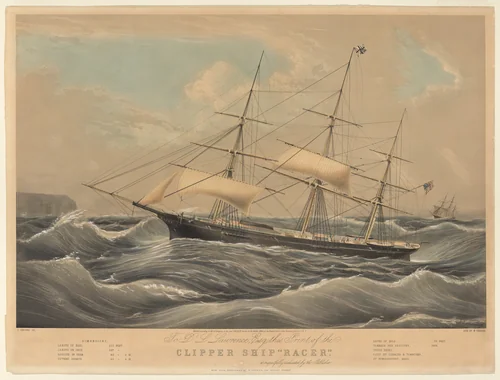
Buttersworth’s paintings are distinguished by a rare synthesis of technical precision and kinetic drama. He was not merely documenting vessels; he was chronicling the apotheosis of sail. His meticulous attention to rigging, hull architecture, and maritime physics ensured that his finished works served both as compelling art objects and as unimpeachable documents of naval engineering. His style favors dramatic settings, using heightened waves and turbulent skies to emphasize the inherent grace and speed of the subject.
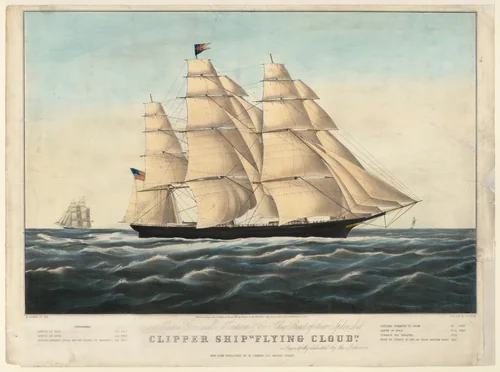
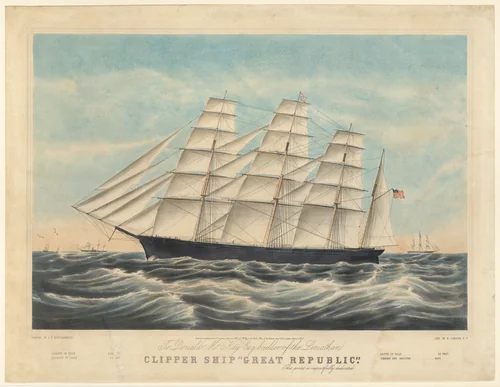
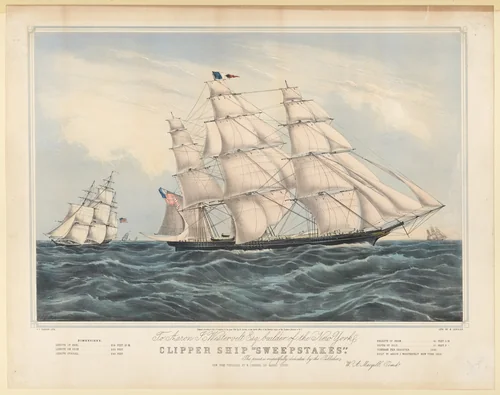
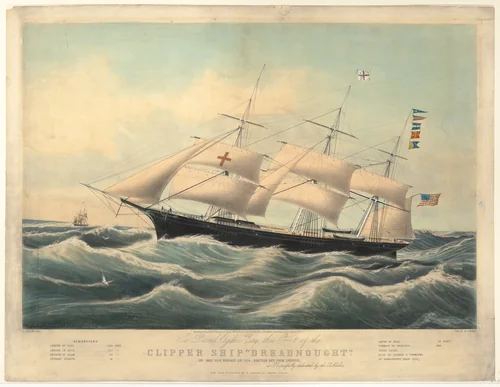
Arriving in New York at the height of the clipper ship boom, Buttersworth expertly captured the competitive spirit inherent in these powerful sailing machines, immortalizing vessels whose names became synonymous with maritime efficiency. Works such as Clipper Ship "Flying Cloud" and the powerful depiction of the Clipper Ship "Great Republic" demonstrate his signature approach: emphasizing sheer speed and command of the ocean. A particular highlight is his record of the Clipper Ship "Dreadnought" off Sandy Hook, February 23, 1854, capturing the vessel shortly after completing a celebrated nineteen-day trans-Atlantic run from Liverpool. It is perhaps no surprise that an artist so focused on efficiency and velocity would himself prove extraordinarily prolific, maintaining an output that was both consistent and uniformly high in quality.
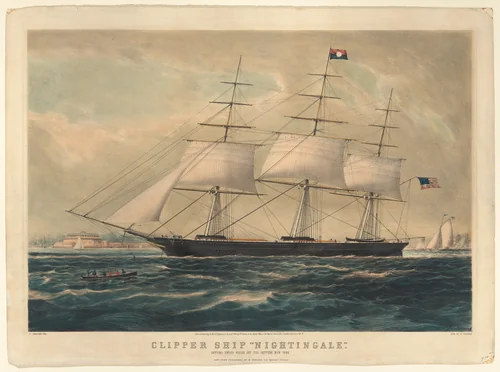
His mastery ensured that nearly every major clipper known to have sailed was subsequently rendered by his hand or adapted into museum-quality prints. Today, Buttersworth’s original James E. Buttersworth paintings are held in the permanent collections of institutions such as the Metropolitan Museum of Art. His visual record of this pivotal era endures, with many of the lithographs derived from his compositions, such as Clipper Ship "Nightingale" getting under weigh off the Battery, New York, now available as downloadable artwork through public domain initiatives, preserving his authoritative vision for new generations.
Source: Wikipedia · CC BY-SA 4.0