Jacques Gamelin
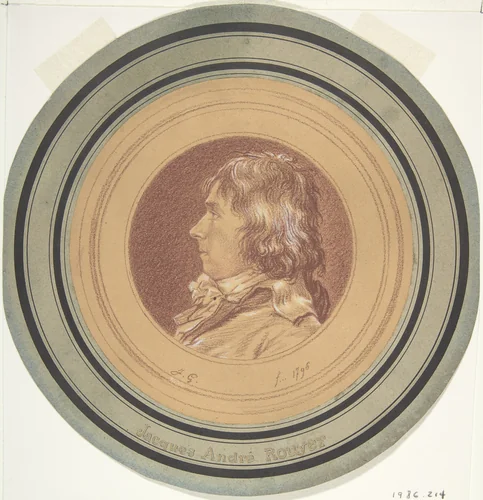
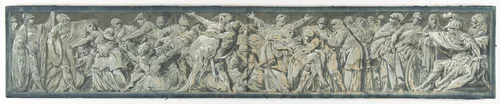
Jacques Gamelin (1750-1803) stands as a distinctive figure of the late French Enlightenment, successfully navigating the demanding fields of academic historical painting and meticulous anatomical illustration. Although today best known for his vivid depictions of battle scenes, exemplified by works such as The Rape of the Sabines, his extensive oeuvre of high-quality prints and drawings secured his enduring reputation across Europe. His achievements are preserved in prestigious institutions globally, including the Metropolitan Museum of Art and the National Gallery of Art.
Born in Carcassonne, Gamelin initially followed the expected trajectory of a merchant’s son, receiving a Jesuit education before being placed in the service of the wealthy industrialist, Baron de Puymaurin, in Toulouse. Puymaurin quickly observed that the young assistant possessed little aptitude for commerce but significant artistic promise. This pivotal realization, leading to the Baron’s financial sponsorship of Gamelin’s studies against the wishes of his family, highlights a fascinating instance of artistic recognition triumphing over mercantile necessity.
Puymaurin funded Gamelin’s five years at the Académie royale de Toulouse, where the artist secured first prize. This success paved the way for advanced study in Paris and later in Rome. There, Gamelin refined his emergent Neoclassical style studying under influential masters Jacques-Louis David and Joseph-Marie Vien, ultimately earning him the distinguished position of painter to Pope Clement XIV.
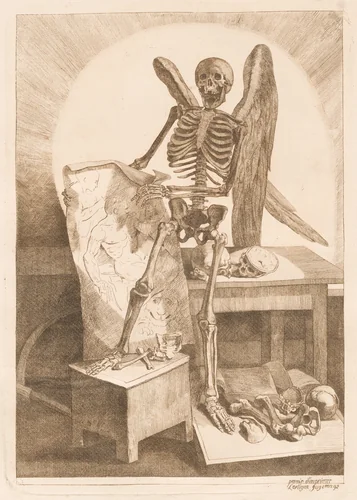
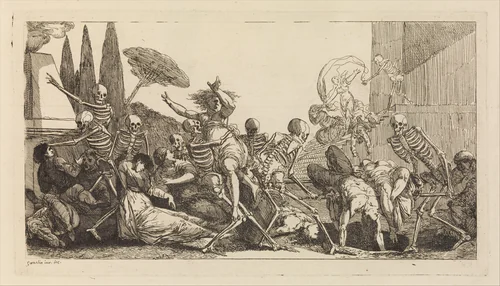
Gamelin's most technically ambitious contribution lies within his published work, notably Nouveau Recueil d'Ostéologie et de Myologie (A New Collection of Osteology and Myology). This significant 1779 publication, featuring precise and dramatic engravings like A Winged Skeleton Holding an Anatomical Drawing, demonstrates his mastery of line and form beyond traditional academic subjects and provided crucial visual resources for artists and physicians alike.
Upon inheriting wealth following his father's death, Gamelin returned to France, where he taught at the Toulouse Académie. While his large-scale Jacques Gamelin paintings of cavalry clashes defined his later career, the detailed preparatory sketches and anatomical studies he created remain critical to understanding his methods. Many of his drawings are available today as downloadable artwork within the public domain, ensuring his legacy as a key transmitter of late eighteenth-century Neoclassicism continues to be studied globally.
Source: Wikipedia · CC BY-SA 4.0