Jacques Chéreau
Jacques Chéreau was a crucial figure in the burgeoning commercial print culture of early 18th-century Paris, operating not only as a skilled portrait engraver and printmaker but also as a successful publisher of both fashion plates and innovative optical prints. Active around 1720, Chéreau positioned his operation within the heart of Parisian graphic production, the intensely competitive Rue Saint-Jacques quarter. His business premises, variously identified on his output as "au Grand St. Remy," "au Coq," or "au dessus de la Fontaine St. Severin," reveal the necessary agility and constant re-branding required to thrive in this specialized and dense neighborhood of artists and vendors.
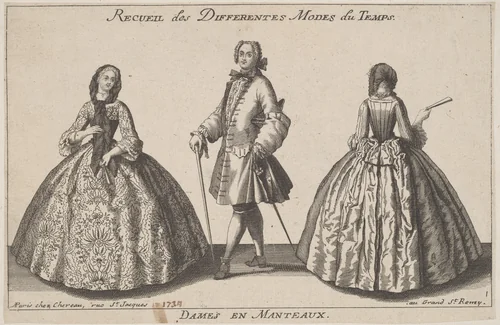
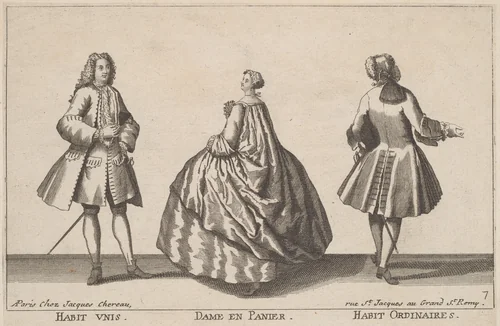
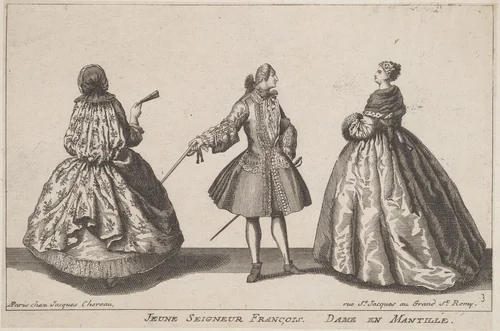
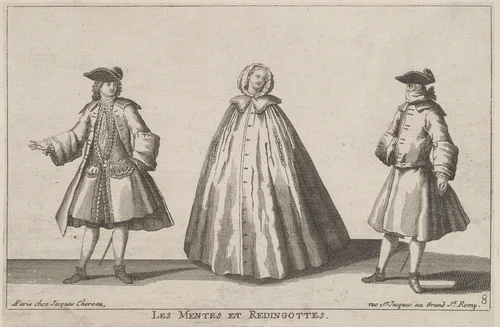
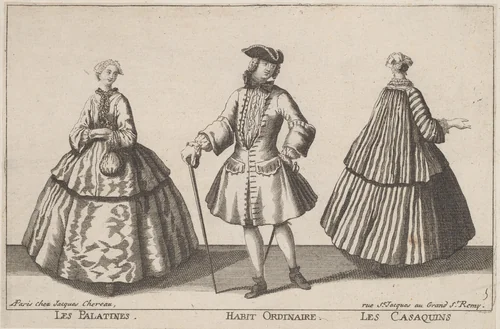
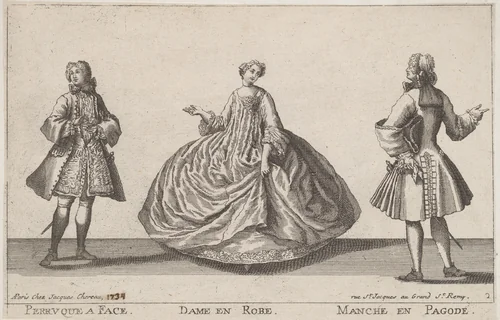
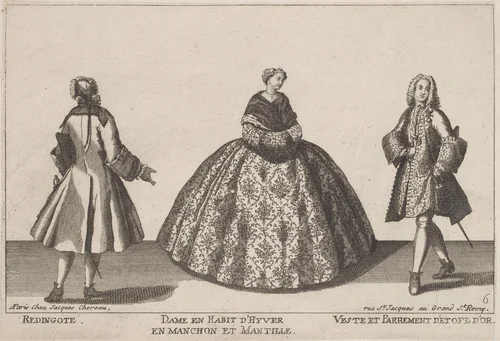
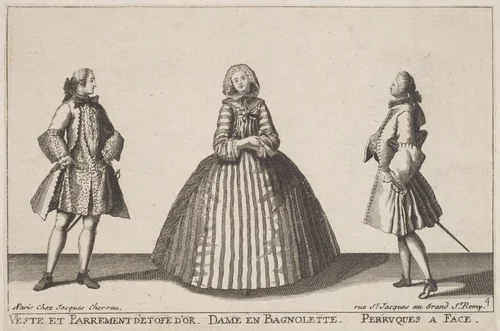
The majority of Chéreau’s identifiable surviving works concentrate on documenting contemporary French fashion, transforming ephemeral trends into durable visual records. Prints such as Dames en Manteaux, Jeune Seigneur François/Dame en Mantille, and Les Palatines/Habit Ordinaire/Les Casaquins function as detailed catalogs of upper-class attire, capturing the precise cut and draping of cloaks, coats, and headwear for both domestic audiences and foreign buyers. These meticulous compositions established Chéreau as an essential documentarian of the era’s social spectacle. It is perhaps a subtle testament to the commercial pressures of the time that, despite the specialized nature of these commissions, Chéreau also produced optical prints, a genre designed for perspective viewing boxes, suggesting a commitment to leveraging all available graphic technologies to maximize market share.
While records of his complete output are limited, the quality of the surviving Jacques Chéreau prints, now held in collections like the National Gallery of Art, confirms his technical mastery of the engraving process. These museum-quality depictions serve as valuable primary sources for scholars studying 18th-century material culture and social history.
Chéreau’s legacy persists through the accessibility of his engravings. Today, reproductions of his work are widely available in the public domain. The clear lines and informative nature of his compositions mean that this downloadable artwork continues to circulate, ensuring that the stylistic nuances documented by Chéreau, from the formality of court dress to the practicalities of ordinary habits, remain fully accessible to researchers and enthusiasts alike.
Source: Wikipedia · CC BY-SA 4.0