Jacopo Guarana
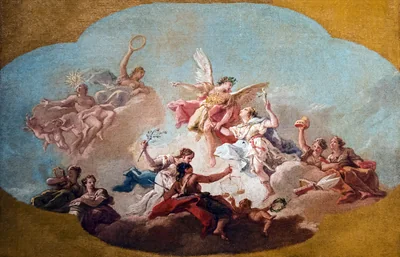
Jacopo Guarana (1720-1783) stands as a significant, though sometimes understated, master of the Venetian late Baroque. Born in Verona, his professional life was dedicated almost exclusively to Venice and its contiguous mainland territories, placing him at the heart of the city's artistic economy during the middle decades of the eighteenth century. His long, productive career saw him execute numerous large-scale fresco cycles and altarpieces, defining the interior aesthetic of many public and private structures of the era.
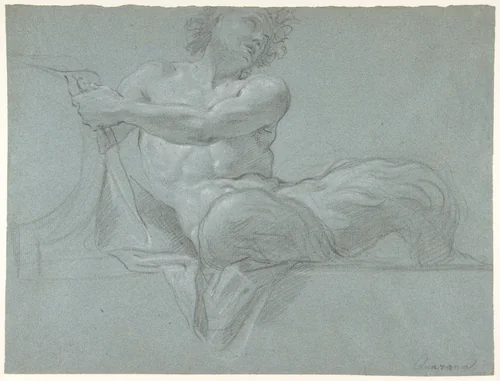
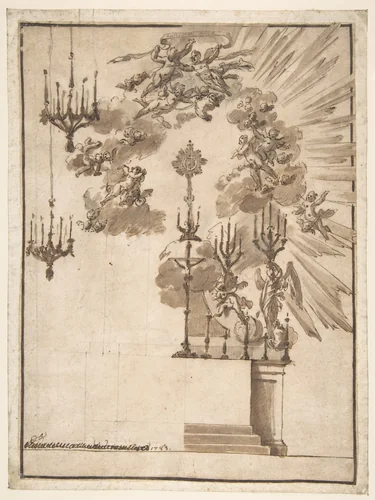
Guarana’s output reveals an assured draftsmanship, a quality perhaps best preserved not in his vast, sometimes deteriorated, ceiling paintings, but in his smaller, preparatory works. These surviving graphic studies, sketches in chalk and wash, offer direct insight into his compositional process and rapid technical facility. Collections such as the Metropolitan Museum of Art and the National Gallery of Art hold excellent examples of this graphic strength, including the dual-sided study, Satyr Reclining on a Ledge, Facing Right (recto) and its mirror image (verso).
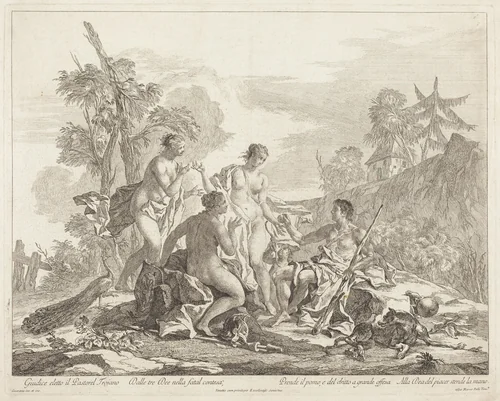
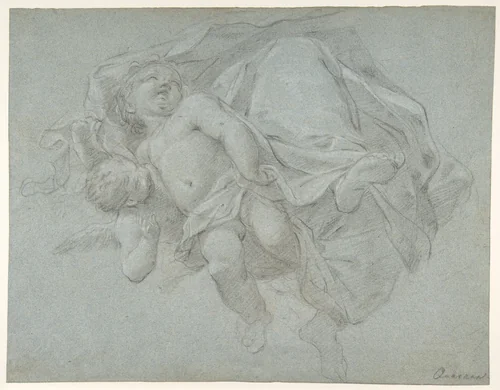
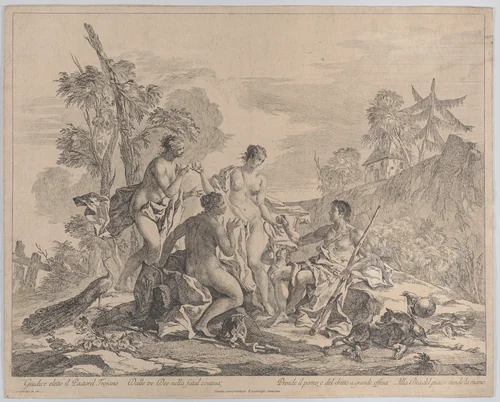
His subject matter frequently drew upon classical mythology, rendered with the light grace and decorative elegance characteristic of the Rococo influence filtering into the Venetian Baroque. The meticulous planning required for such commissions is evident in drawings like Two Putti Supporting the Lower Part of a Draped Figure, which isolates and refines individual elements for a larger composition. Similarly, his treatment of The Judgement of Paris across multiple renderings, including the complete scene where the shepherd Paris is seen "handing an apple to Venus accompanied by two nymphs," demonstrates his reliable efficiency in delivering fashionable mythological narratives.
Unlike some of his more dramatic contemporaries, Guarana maintained a steady, classicizing temperament that favored clarity and controlled movement. One might observe a slight formality in his approach, suggesting an artist perhaps more comfortable with the established demands of the Venetian academy than with avant-garde innovation. Today, enthusiasts and researchers benefit from the accessibility of his work; high-quality prints of many of his original drawings and Jacopo Guarana prints are available as downloadable artwork, ensuring that the legacy of this central Venetian painter continues to be studied far beyond the palazzi he decorated.
Source: Wikipedia · CC BY-SA 4.0