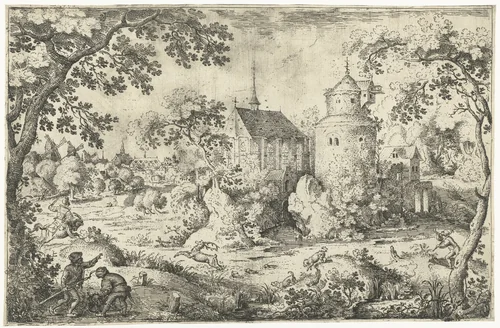
Jacob Savery
Jacob Savery the Elder (active 1575-1590) was a pivotal figure in the transition of late-sixteenth-century artistic styles from the Southern Netherlands to the emergent Dutch Republic. Trained in Antwerp, then a center of artistic innovation, Savery distinguished himself as a versatile draughtsman, etcher, and painter, specializing in subjects that would later define the Dutch Golden Age: still lifes, animal studies, and atmospheric landscapes.
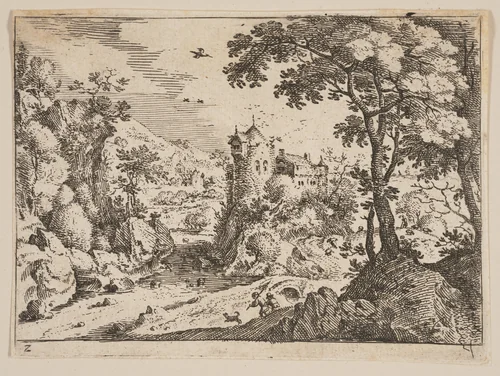
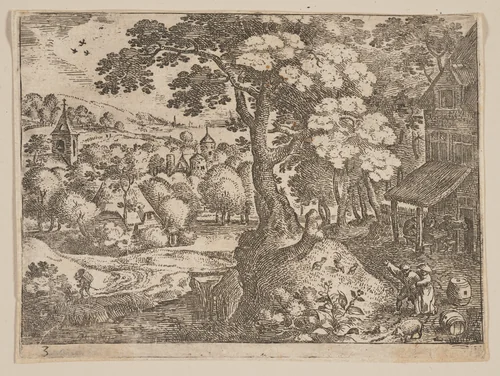
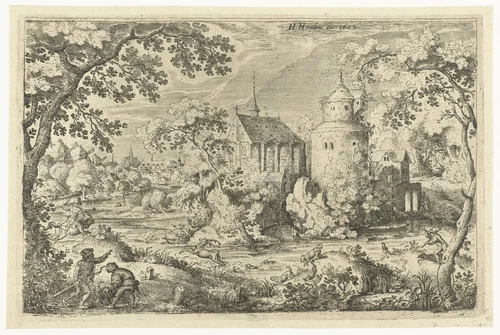
Following the political and religious upheaval that necessitated his relocation to the northern provinces after 1584, Savery’s output intensified, moving away from overtly moralizing scenes toward nuanced observational studies. His surviving body of graphic work, consisting of over a dozen documented prints and numerous drawings, establishes him as a skilled practitioner of landscape etching. Works such as Landschap met reiziger bij herberg and Gezicht op een kasteel exemplify his ability to integrate detailed architectural elements with broad, atmospheric distances. These small-scale compositions, often featuring weary travelers, soldiers, and ordinary encounters, demonstrate an early attention to narrative genre and the movement of people through nature, anticipating the topographical focus of later Dutch masters.
Savery’s significance extends beyond his direct artistic output, profoundly influencing his sons, notably Roelant Savery, who achieved international renown. Jacob’s own promising career was tragically cut short by the plague around 1590, just as the artistic landscape of the Northern Netherlands was truly beginning to cohere. It is a subtle irony that the artist who helped transport the energy of Antwerp to the new Dutch center did not live to fully witness the revolution he helped initiate.
Today, many of his finest drawings and plates reside in major international institutions, including the Rijksmuseum, the National Gallery of Art, and the Art Institute of Chicago. The robust lines and detailed compositions of Jacob Savery prints remain highly valued by curators and scholars. Fortunately, much of this graphic material is now in the public domain, allowing institutions and enthusiasts to access downloadable artwork that preserves his high-quality contribution to early Netherlandish printmaking.
Source: Wikipedia · CC BY-SA 4.0