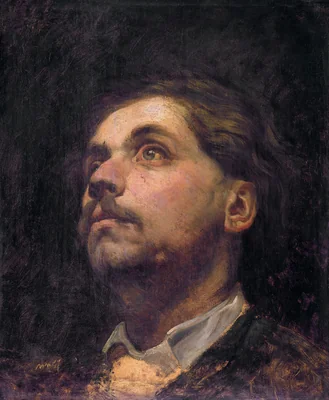
Jacob Maris
Jacob Henricus Maris (1837-1899) stands as the principal figure within the Hague School, a pivotal movement that redefined Dutch painting in the late nineteenth century. Alongside his brothers, Willem and Matthijs, Jacob Maris helped shift the artistic focus from historical narrative toward atmospheric, often melancholic, renderings of the local environment. He quickly emerged as the most important and influential Dutch landscape painter of the final quarter of the century, achieving widespread recognition for his masterful control over light and shadow, particularly in depicting the vast, low-lying skies characteristic of the region.
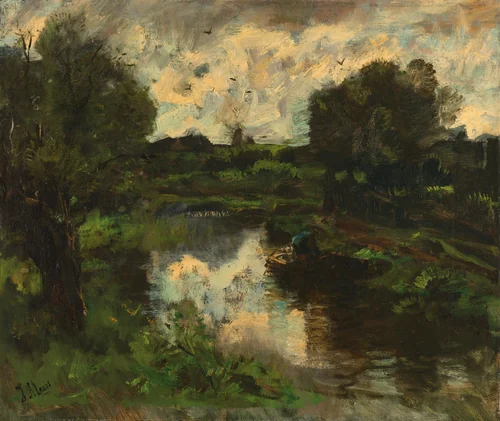
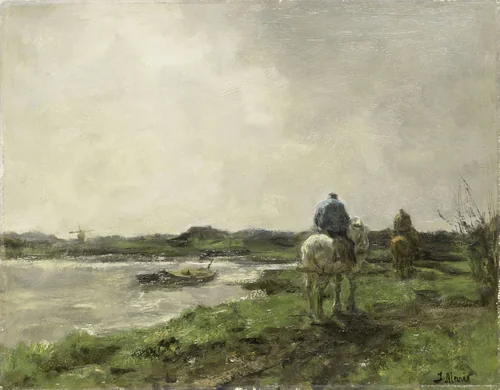
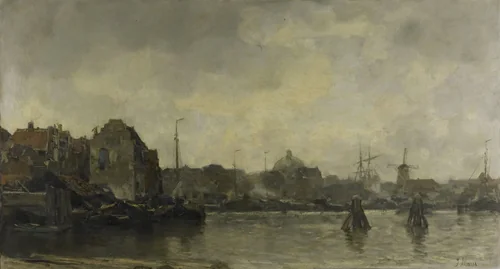
Maris’s early training under painter J.A.B. Stroebel (1849-1852) provided a solid technical foundation, but his mature style is defined by a distinctive commitment to mood over empirical detail. Unlike earlier Romantic interpretations, Maris approached the Dutch countryside with sober realism, transforming mundane scenes, such as Vaart met brug (Canal with Bridge) and Dutch Canal, Rijswijk, into evocative studies of atmosphere. Works like Landschap met molen bij maanlicht (Landscape with Mill by Moonlight) further demonstrate his powerful command of nocturnal lighting, establishing a visual gravitas that resonated deeply with collectors in Europe and America.
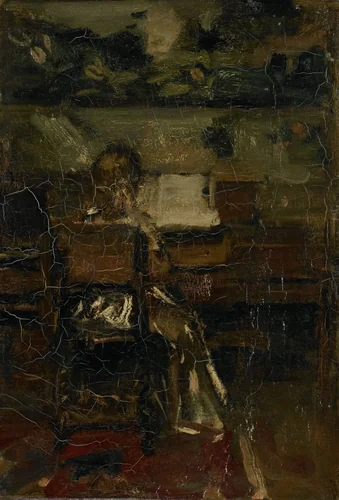
While Maris is rightly celebrated for his evocative landscapes, his overall body of work exhibited surprising stylistic breadth. Notably, he collaborated extensively with his brother Matthijs on a series of significant portraits commissioned by the royal House of Orange. Yet, perhaps his most intriguing departures lie in figure studies like Praying Monk (Monk at his Devotions), which contrasts sharply with his expansive skies. It is fascinating to observe how an artist so adept at capturing the immense emptiness of a North Sea beach, as seen in Ship on the Scheveningen beach, could invest equal weight into the quiet introspection of a solitary figure.
Maris’s contributions elevated the Hague School globally, ensuring that these distinct, gray-toned visions of the Netherlands secured a permanent place in the international canon. His legacy is firmly established within major institutions, with significant Jacob Maris paintings held in the National Gallery of Art, the Metropolitan Museum of Art, and the Rijksmuseum. Given the age and historical importance of these masterful works, high-quality prints derived from many of his pieces are often available in the public domain, allowing new generations to appreciate his profound influence on modern landscape painting.
Source: Wikipedia · CC BY-SA 4.0