Jacob de Gheyn II
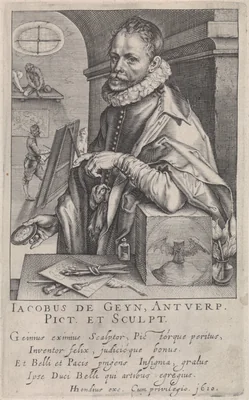
Jacob de Gheyn II (1565–1629) was a pivotal Dutch artist whose prolific output as an engraver and draftsman fundamentally documents one of the most significant shifts in Northern European visual culture. Working primarily in Leiden and The Hague, De Gheyn’s career trajectory maps the formal evolution from the hyper-stylized vocabulary of Northern Mannerism toward the naturalistic observational precision that would define the Dutch Golden Age. While he later turned to painting, his enduring legacy rests upon his mastery of the burin and his influential contributions to the graphic arts.
De Gheyn initially trained in the Mannerist tradition, producing works characterized by elaborate complexity and dramatic figuration. This early virtuosity is evident in intricate biblical cycles, such as the series including Plate 10: Naphtali, Plate 11: Joseph, and Plate 12: Benjamin, wherein detailed line work and complex composition are paramount. As the sixteenth century drew to a close, however, his focus sharpened. His later graphic works began to prioritize a more immediate connection to reality, employing subtle light, authentic anatomical structure, and a profound interest in capturing the psychological immediacy of his subjects.
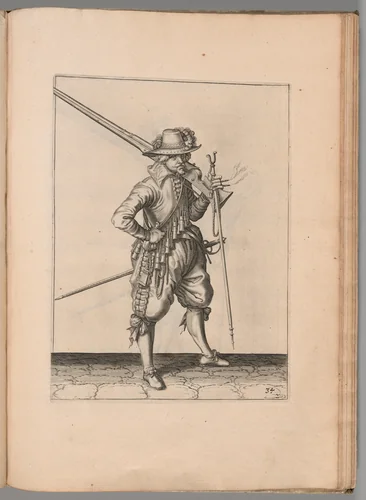
This transition is powerfully illustrated in his studies of military life. Prints like the focused study of the Artilleryman and the highly detailed Plate 2: Levi display an unparalleled technical control and an emerging interest in genre painting, lending the common soldier an unexpected dignity. It is an understated observation of the period that few artists managed to render the processes of military drill and daily duty with such visual elegance. De Gheyn was not merely documenting; he was establishing a foundational visual language for subsequent realism.
The technical complexity and innovation demonstrated in Jacob de Gheyn II prints ensure their continuous study in major institutions globally. His works are held in the permanent collections of respected institutions such as the Art Institute of Chicago and the Cleveland Museum of Art, reflecting his lasting historical impact. Today, much of the artist's critical output is considered public domain, ensuring widespread accessibility. This status allows scholars and enthusiasts worldwide access to museum-quality reproductions and high-quality prints, solidifying De Gheyn’s position as a crucial forefather of seventeenth-century Dutch realism.
Source: Wikipedia · CC BY-SA 4.0