Ivan Kliun
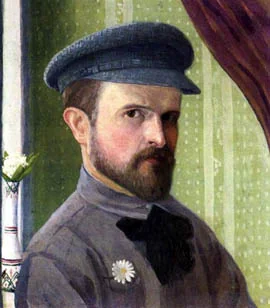
Ivan Vasilievich Kliun (born Klyunkov) was a pivotal Russian Avant-Garde figure, functioning simultaneously as a painter, sculptor, and dedicated art theorist. A key associate of Kazimir Malevich, Kliun was instrumental in the evolution of Russian non-objective art, dedicating his most active years, 1915 to 1928, to exploring the aesthetic potential of pure geometry.
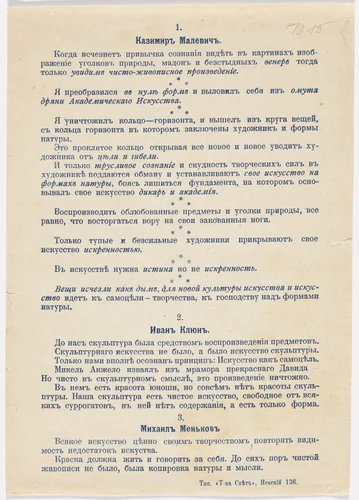
Kliun’s theoretical output provided essential intellectual scaffolding for the emerging revolutionary aesthetic. He was a central participant in the creation of the Suprematist doctrine, and his early commitment is confirmed by his role in producing the Manifesto handbill for the 0.10 exhibition in 1915, the landmark event that formally introduced non-objective painting to the public.
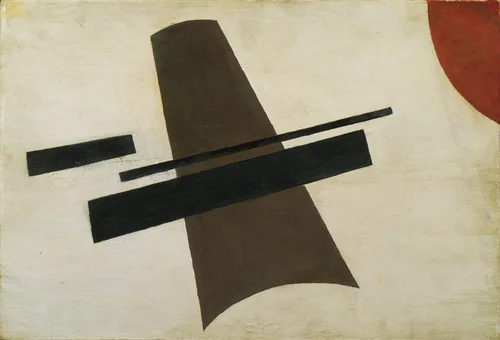
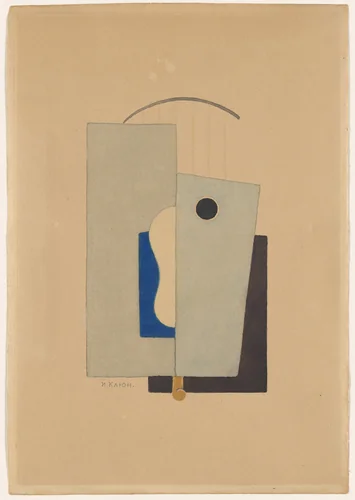
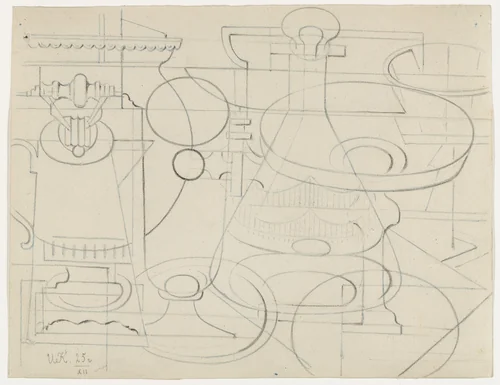
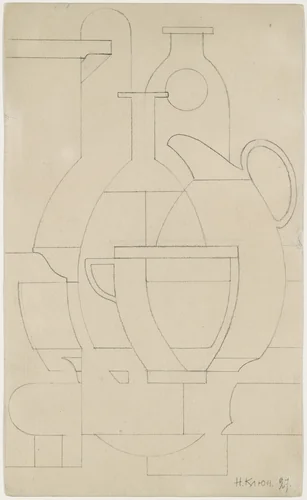
His works from this period, notably Suprematism and the strictly planar Composition, demonstrate his rigorous exploration of color interaction and the dynamic tension created by geometric forms placed within an open field. Unlike some of his contemporaries who aggressively rejected all prior forms of art, Kliun maintained a thoughtful engagement with objective reality even as he pursued abstraction. He was capable of producing canvases of the utmost geometric purity while retaining an almost paradoxical appreciation for the traditional visual problems of light and volume, as seen in analytical still life works such as Cup, Pitcher, Bottles.
This versatility reveals an independent critical stance within the Avant-Garde community. Kliun’s ability to articulate the precise relationships between color, material, and weight allowed him to function effectively across diverse media, bridging the theoretical gap between two-dimensional painting and the spatial challenges of sculpture.
The concise and powerful visual vocabulary evident in Ivan Kliun paintings ensured their lasting significance. His compositions are today held in major collections, including the Museum of Modern Art, establishing their status as museum-quality historical documents of the period. For those interested in the foundational movements of Modernism, Kliun’s work offers a valuable look at geometric refinement outside the immediate shadow of Malevich. Fortunately, many of his abstract designs are increasingly accessible as high-quality prints, allowing a wider audience to study his systematic yet visually compelling aesthetic language.
Source: Wikipedia · CC BY-SA 4.0