Isaac H. Bonsall
Isaac H. Bonsall was an influential early American photographer whose active career, spanning approximately 1859 to 1864, captured the critical geographical and historical features of the American South just prior to the outbreak of the Civil War. Though his documented artistic output is small, comprising only five known photographs, these works are recognized for their historical clarity and technical precision, securing them places in major institutional holdings, including the Metropolitan Museum of Art and the National Gallery of Art.
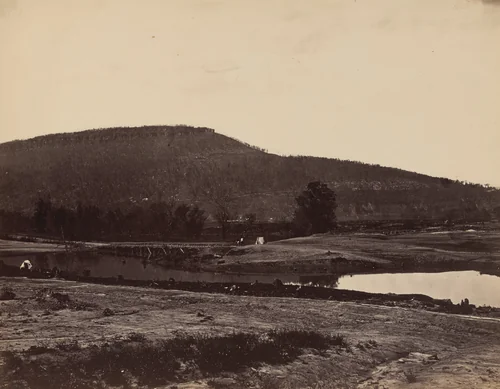
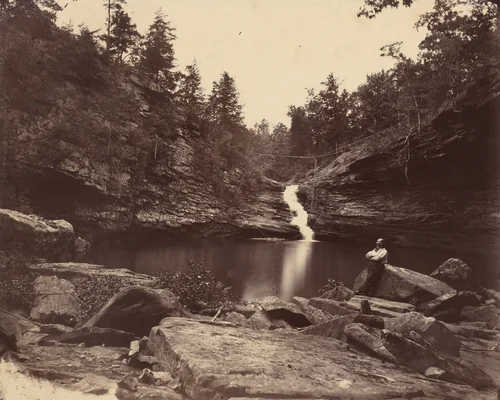
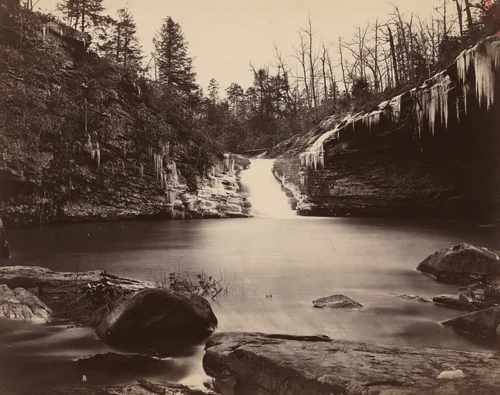
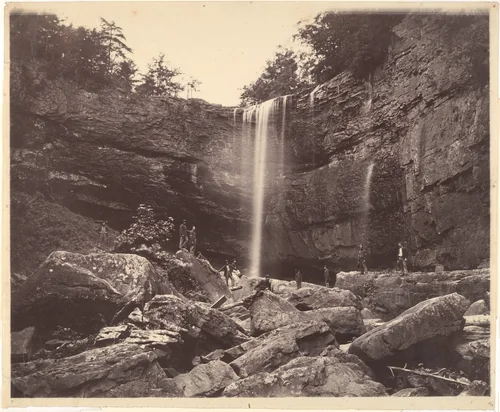
Bonsall’s subject matter focused tightly on the dramatic topography surrounding Lookout Mountain, situated near Chattanooga, Tennessee and Georgia. His lens fixed on areas of natural majesty that would soon become key strategic locations in military conflict. Photographs like Lula Lake, Upper Falls, Lookout Mountain, Georgia and Lulah Falls, Lookout Mountain, Georgia document these significant waterways and elevations with an objective eye, blending the demands of early landscape photography with the emerging need for precise topographical record-keeping. The resulting images are highly detailed and function as crucial historical markers of the undeveloped environment.
The brief duration of his photography career lends a distinct focus to his limited surviving body of work. Bonsall achieved a standard of visual excellence that makes his compositions enduring examples of museum-quality American landscape photography from the period. For instance, the image simply titled Chattanooga, Tennessee, South End provides a rare, unvarnished glimpse into the built environment of a nascent industrial town destined for national attention.
Following this intense photographic period, Bonsall abruptly pivoted to civic life in the burgeoning Western territories. He established himself as an early settler of Kansas, where he served simultaneously as a justice of the peace for Creswell Township, a census taker, and a U.S. Commissioner for Kansas. It is a curious and telling biographical footnote that a man so adept at freezing momentary landscapes on glass plates would dedicate his later years to the meticulous political task of measuring, defining, and settling the nation’s rapidly moving frontier. While his original photographic works are scarce, the historical value of his images ensures they remain vital, and high-quality prints derived from his visual record are now widely available as royalty-free art through public domain archives.
Source: Wikipedia · CC BY-SA 4.0
![[Lula Lake and Upper Falls on Rock Creek, near Lookout Mountain, Georgia] by Isaac H. Bonsall, photograph, 1864-1865](https://img.artbee.org/6e07f84f-ab5d-442f-913e-ab383cf7c242/small.webp)