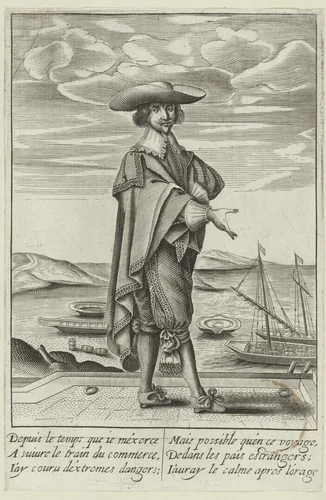
Isaac Briot
Isaac Briot (1585-1670) was a pivotal French engraver and draughtsman whose active period, roughly 1610 to 1630, coincided with the consolidation of power under Louis XIII and the expansion of the Parisian art market. A skilled practitioner of the burin, Briot’s output is distinguished by its technical discipline and narrative clarity, ensuring his prints remain key visual documents of early seventeenth-century France.
His technical approach aligned closely with the established rigor of the Wierix family tradition, characterized by meticulously rendered detail and tightly controlled line work. However, unlike many contemporaries who primarily served as reproductive engravers, Briot often engraved plates taken directly from his own drawings. This practice allowed him unusual control over the final presentation, lending his small but compelling oeuvre a distinct stylistic coherence.
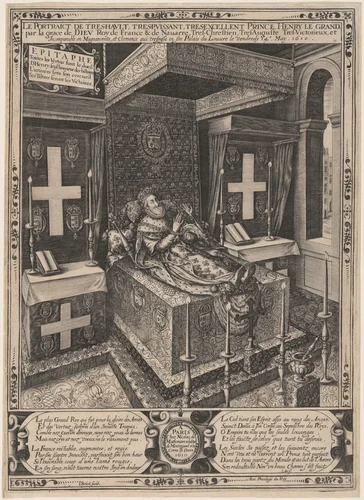
Briot successfully navigated the disparate demands of high-level commemorative commissions and observational genre scenes. His ability to capture a critical historical event is demonstrated in the solemn Le portraict de tres-haut...Henry Le Grand, which depicted the beloved Henri IV on his deathbed, providing a crucial early record of royal commemoration.
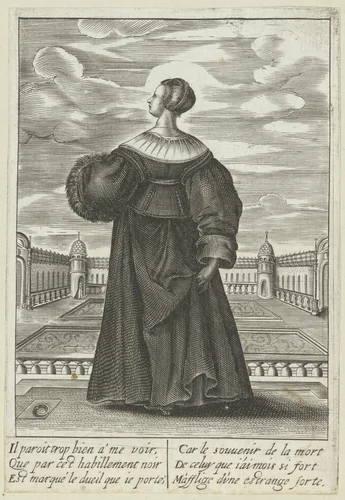
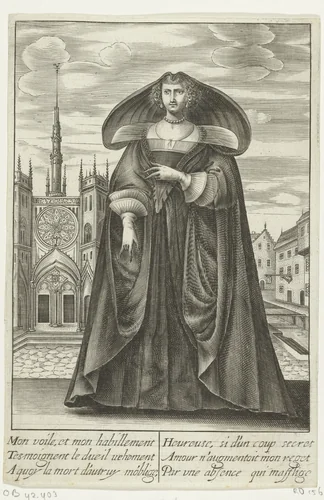
He demonstrated an equally meticulous attention to detail when recording the everyday, translating the bustling activity of the Parisian urban environment into permanent visual records. Works such as Franse dame in rouwkleding in een paleistuin and Franse koopman aan de kade reveal a keen observational eye for social codes and urban commerce. While capable of documenting the gravitas of kings and scholars, Briot also displayed an unexpected affinity for recording the precise, sometimes elaborate, ritual of Parisian mourning attire, providing us with surprisingly detailed visual documentation of specific early seventeenth-century fashion.
Today, Briot’s high-quality prints are held in esteemed collections, including the Rijksmuseum and the National Gallery of Art. The lasting integrity of his line work ensures that reproductions remain museum-quality artifacts. As many of these historical works now reside within the public domain, they are increasingly accessible as downloadable artwork, allowing modern audiences to study the refined draughtsmanship of this influential French master.
Source: Wikipedia · CC BY-SA 4.0