Hugh William Williams
Hugh William Williams (c. 1773-1829), formally known as "Grecian Williams," was a Scottish landscape painter whose work profoundly influenced the early 19th-century Neo-classical interpretation of the Mediterranean world. Despite being permanently based in Scotland, earning him a Fellowship of the Royal Society of Edinburgh (FRSE), his formidable reputation was built upon extensive travel through Greece and Italy, providing the British audience with detailed, atmospheric views of classical sites.
Williams’s drawings and watercolors, predominantly dating from his documented active period between 1816 and 1818, demonstrate an exacting synthesis of topographical accuracy and Romantic temperament. He excelled at rendering architectural ruins within immense, dramatic landscapes, a skill appreciated by major institutions today; original works and museum-quality studies are held in collections including the Metropolitan Museum of Art and the Rijksmuseum.
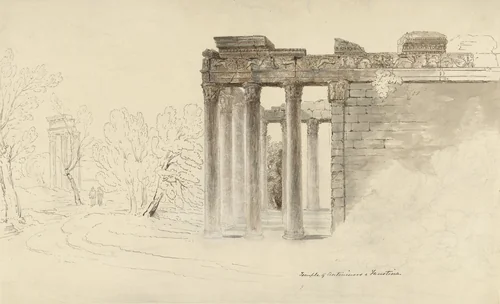
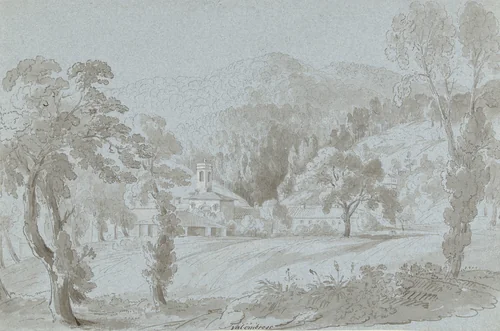
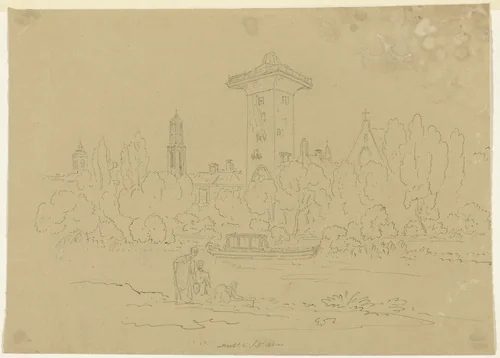
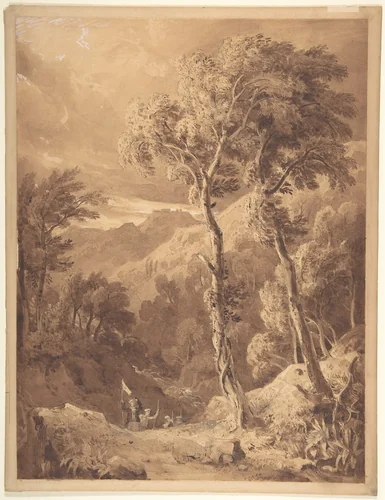
His surviving oeuvre illustrates this geographical breadth. From the highly specific rendering of the Roman forum in De tempel van Antoninus en Faustina te Rome, to the lush, enveloping nature found in Gezicht bij Vallombrosa, ten oosten van Florence, Williams showcased versatility in capturing both history and environment. Other notable pieces include the dramatic view of the Netherlands in Gezicht op de Smeetoren te Utrecht and the evocative light captured in Gezicht op het meer van Nemi. However, it is his work defining the Greek interior, such as Mountainous landscape with travellers (Scene on the river Pellene Achaia), that best exemplifies the precision which earned him his enduring nickname.
The enduring appeal of Hugh William Williams prints lies in their technical mastery and clarity. It is perhaps the artist's subtle personality, a consistent merging of objective documentation with subjective awe, that gives his work its lasting resonance; an artist whose artistic focus was often thousands of miles from his Scottish studio. Today, researchers often seek downloadable artwork of his pieces, which, due to careful archival work, are increasingly available to the public domain.
Source: Wikipedia · CC BY-SA 4.0