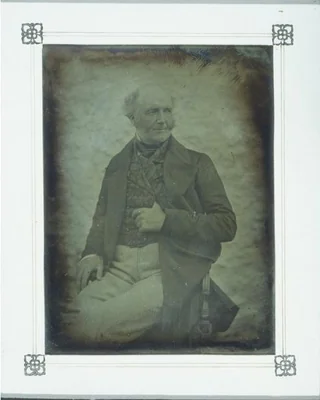
Horatio Ross
Horatio Ross (1804-1886) holds a distinct position in the history of early photography, celebrated not as a professional practitioner but as a dedicated pioneer amateur. Active primarily during a short, intense period between 1853 and 1856, Ross leveraged the burgeoning technology of the camera to document his profound passion for the Scottish Highlands, fusing the technical precision of early calotype and collodion processes with the sensibilities of the sporting gentleman.
Ross’s photographic career reflects the close relationship between the medium’s early adoption and the Victorian upper class, for whom expensive and complex equipment provided a sophisticated means of observation. His limited output, totaling approximately fifteen known photographs, centered almost exclusively on the landscapes surrounding his properties and the rigorous pursuit of game. This focus resulted in images that are technically rigorous and atmospherically rich, capturing the remote ruggedness of locations such as Glen Forsa, Isle of Mull. His mastery of composition, despite his amateur designation, often achieved a museum-quality standard, revealing a keen eye for tonal nuance in the demanding light of northern latitudes.
The photographs of this period display a preference for water, often utilizing reflective rivers to deepen the spatial complexity of works like the series of River Landscape, Scotland. Perhaps his most distinctive work is the intriguing Horace and Edward Stalking Stags, which transforms a field sport into a calculated, almost formal, geometric composition. It is worth noting, given Ross’s reputation as one of Britain’s most celebrated competitive shots, that he approached the framing of a landscape with the same exacting precision he applied to sighting a target, providing a lighthearted insight into his artistic discipline.
Though his output was small, Ross’s contribution is recognized through the inclusion of his works in major institutional holdings, including the Metropolitan Museum of Art, the Cleveland Museum of Art, and the National Gallery of Art. Due to the historical nature of his practice, these powerful images are now often designated as public domain works. Scholars and collectors seeking access to the technical brilliance of the Victorian amateur can readily find high-quality prints and downloadable artwork derived from his original negatives, ensuring the continued study of this unique early vision.
Source: Wikipedia · CC BY-SA 4.0
![[Stag in Cart] by Horatio Ross, photograph, 1856-1860](https://img.artbee.org/15595171-dfe7-4e46-ab50-a9c268778f01/small.webp)
![[Stags Heads - Dibedale] by Horatio Ross, photograph, 1856](https://img.artbee.org/275736c7-3803-42b0-8ac6-e6fb9fcd9515/small.webp)
![[Tree] by Horatio Ross, photograph, 1856-1860](https://img.artbee.org/72ad1fd9-ec23-4c3c-a876-5788f2746d16/small.webp)
![[View in the Gardens at Netherley] by Horatio Ross, photograph, 1856-1859](https://img.artbee.org/e38db613-de98-41b8-95a7-905c653a0863/small.webp)
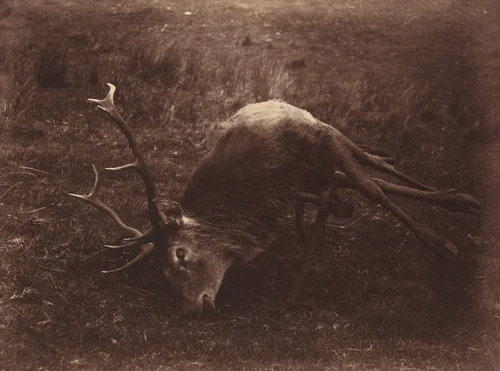
![[Dead Stag] by Horatio Ross, photograph, 1857](https://img.artbee.org/c4ac8997-2837-4c31-a402-b379732b2062/small.webp)
![[Hunters Stalking a Deer] by Horatio Ross, photograph, 1857](https://img.artbee.org/8f918a16-99c4-479a-9f96-adf4ee0bfee2/small.webp)
![[Ned and Colin Ross with Hunt Trophy] by Horatio Ross, photograph, 1857](https://img.artbee.org/960df085-06e7-47d3-96c2-4ce845749832/small.webp)
![[Stag Shot by Mrs. Ross] by Horatio Ross, photograph, 1857](https://img.artbee.org/58c15fb6-2b85-4386-8ffd-0600f3779530/small.webp)
![[Stag Trophy Head Killed by Ned Ross] by Horatio Ross, photograph, 1857](https://img.artbee.org/a4519816-3dea-4f1f-b967-eaeceb0e4809/small.webp)
![[Colin and Horatio Ross Reading with Jessie Macrae] by Horatio Ross, photograph, 1858](https://img.artbee.org/7b2fee85-0b7f-4917-9287-775245c6f399/small.webp)
![[Edward Ross, Youngest Son of Horatio Ross] by Horatio Ross, photograph, 1858](https://img.artbee.org/472f0718-797b-41d1-8915-b4aa38a46db3/small.webp)
![[Macrae, Ross, and Warner Families Outdoors] by Horatio Ross, photograph, 1858](https://img.artbee.org/4424ab9f-675f-49f6-9f5b-5b349a5359c8/small.webp)
![[Miss Macrae of Inverinate, Wife of Horatio Ross] by Horatio Ross, photograph, 1858](https://img.artbee.org/c8130b99-19dd-43e6-8760-73f01792f47b/small.webp)
![[Mrs. Kennedy] by Horatio Ross, photograph, 1858](https://img.artbee.org/a8258a1b-6a8e-4e5b-a8ab-1a621e149549/small.webp)
![[Peel Ross, Son of Horatio Ross] by Horatio Ross, photograph, 1858](https://img.artbee.org/184a3124-7484-4013-815b-1b2713e15566/small.webp)
![[Spying in Glenfeshie] by Horatio Ross, photograph, 1858](https://img.artbee.org/fc19a53e-d3c3-4279-9d3f-cc31ae335980/small.webp)
![[Stag Trophy Head, Killed by Ned Ross] by Horatio Ross, photograph, 1858](https://img.artbee.org/68473c89-0b5e-4b27-963b-8ee4aad455f8/small.webp)
![[Two Stags and Roe Buck] by Horatio Ross, photograph, 1858](https://img.artbee.org/61d81695-ab0e-464c-a75e-59b2eb57e8bb/small.webp)
![[Two Stags, One Shot by Mr. Ross and the Other by Mrs. Ross] by Horatio Ross, photograph, 1858](https://img.artbee.org/514073c7-501f-429a-b08a-46c23c92b887/small.webp)