Horatio Greenough
Horatio Greenough (1805-1852) stands as one of the preeminent figures of early American Neoclassical sculpture, actively working from 1805 through 1850 during the nation’s formative artistic period. A committed classicist, he achieved national recognition primarily through two monumental United States government commissions: the iconic statue of George Washington (1840), originally intended for the U.S. Capitol Rotunda, and the ambitious allegorical marble group The Rescue (1837-1850), completed for the East Portico. These demanding projects, often requiring years of labor and complex political navigation, positioned him at the center of the burgeoning American art establishment.
Greenough trained extensively in Florence, adopting the rigorous, idealized forms of the ancient world. His commitment to classical precedent was often unwavering, sometimes to his detriment. His interpretation of the first President, for instance, sparked immediate controversy: depicting Washington semi-nude, draped in a toga, and posed in the manner of Phidias’s statue of Olympian Zeus, was perhaps too literal an interpretation of classical ideals for a young, self-conscious republic eager for strictly native iconography. This early artistic friction illustrates the tension between mandatory European training and emerging American visual identity during the Antebellum period.
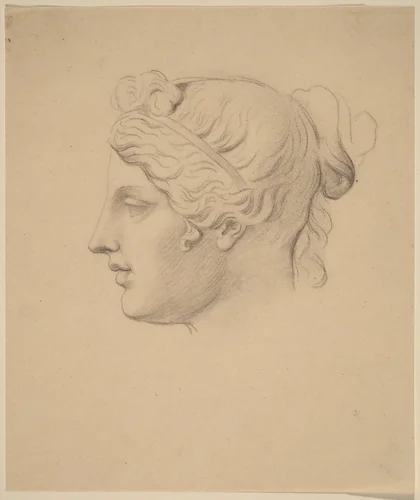
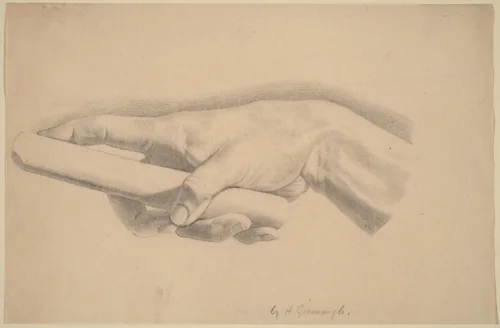
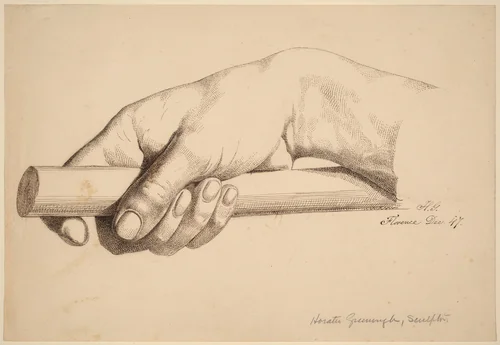
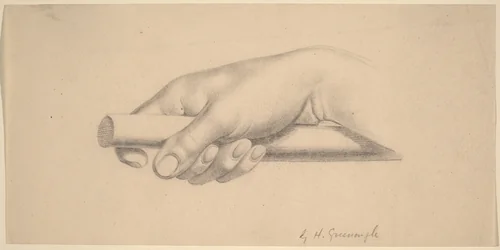
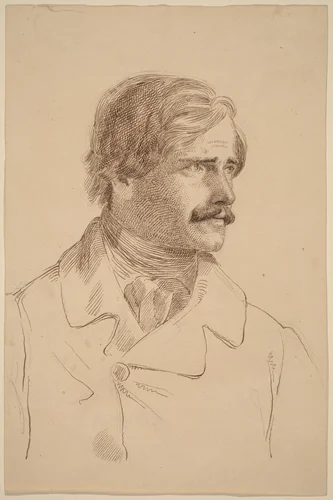
While Greenough is primarily known for these towering national works, the artist maintained a prolific studio practice, evidenced by his surviving corpus of preparatory studies. His relatively modest collection of known drawings, including the precise Classical Head in Profile and the meticulous Study of a Hand, provides essential insight into the foundational anatomical and conceptual planning required for his large-scale sculptures. These detailed graphite works, such as those detailing the anatomy of the hand, reinforce his dedication to classical draftsmanship and detail. Today, the enduring legacy of his technique is accessible through museum-quality reproductions. Interest in Horatio Greenough prints continues to grow among collectors seeking high-quality prints of early American master drawings from the era.
Source: Wikipedia · CC BY-SA 4.0