Hippolyte-Auguste Collard
Hippolyte-Auguste Collard was a photographer active over three decades, from 1838 until 1871. His documented output centered primarily on architectural documentation and monumental engineering works, though his final known photographs captured significant Parisian political unrest. Seven of his photographs are represented in major international museum collections, establishing his work as a critical record of mid-19th-century French infrastructure and urban change.
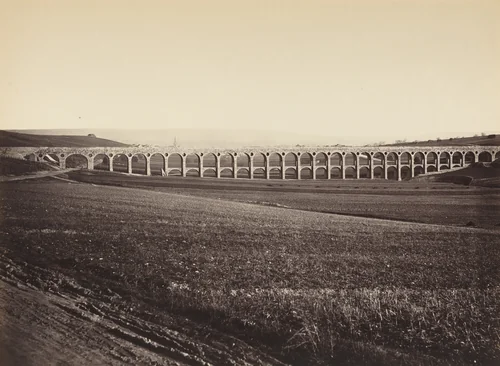
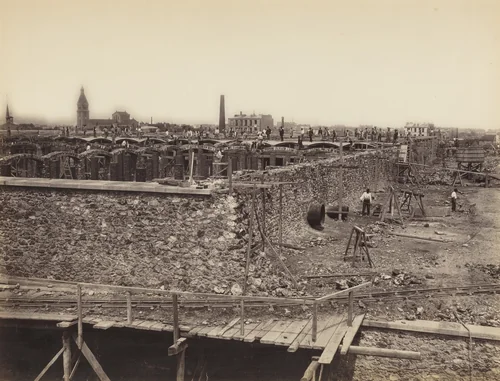
Collard’s technical precision is evident in works focusing on large-scale construction, such as the structural study Arcades de pont sur Vanne (Arcades, Bridge over the Vanne) and the engineering documentation Réservoir de Montrouge, basin supérieur, côté droit (Montrouge Reservoir, Upper Basin, Right Side). The historical significance of his later work is particularly pronounced, featuring immediate documentation of the destruction following the 1871 Paris Commune, notably in images depicting [The Vendôme Column After Being Torn Down by the Communards] and the devastation of [The Hötel de Ville after the Commune].
Works by Collard are held in prestigious collections including the Metropolitan Museum of Art and the National Gallery of Art. Collard’s factual and detailed approach ensures his images serve as valuable historical documents, often utilized for museum-quality reproductions. Because much of his historic photographic archive is now in the public domain, high-quality prints of Hippolyte-Auguste Collard prints are widely available for study and appreciation.
Source: Wikipedia · CC BY-SA 4.0
![[The Vendôme Column After Being Torn Down by the Communards] by Hippolyte-Auguste Collard, photograph, 1870-1879](https://img.artbee.org/9f4633d4-e02c-455b-ad85-55678de9d99e/small.webp)
![[Barricades pres de Ministere de la Marine et l'Hötel Crillon] by Hippolyte-Auguste Collard, photograph, 1871](https://img.artbee.org/8fb53a47-d2c7-46b2-9850-6149f0ce2325/small.webp)
![[The Hötel de Ville after the Commune] by Hippolyte-Auguste Collard, photograph, 1871](https://img.artbee.org/11416d69-1b3c-4e7c-a545-46962e931e2e/small.webp)
![[The Tuileries After Its Destruction by the Communards] by Hippolyte-Auguste Collard, photograph, 1871](https://img.artbee.org/63eda258-5c6b-4c19-a647-ec52fb938e0e/small.webp)
![[The Tuileries after the Commune] by Hippolyte-Auguste Collard, photograph, 1871](https://img.artbee.org/2c1a5534-137d-434c-92a8-68f368ee4461/small.webp)