Hieronymus Andreae
Hieronymus Andreae (c. 1494–1556), variously known as Hieronymus Andreä or Formschneider, stands as one of the most significant German masters of print production during the early 16th century. Operating variously as a woodblock cutter, printer, publisher, and typographer, his formidable career was defined by an exceptionally close and productive association with Albrecht Dürer, forging a partnership crucial to the dissemination of Renaissance German visual culture.
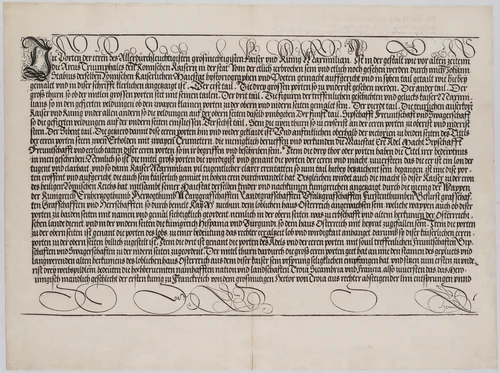
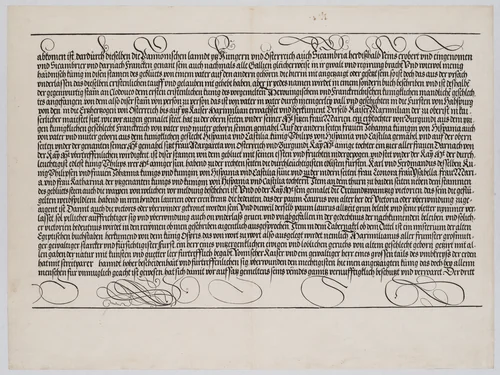
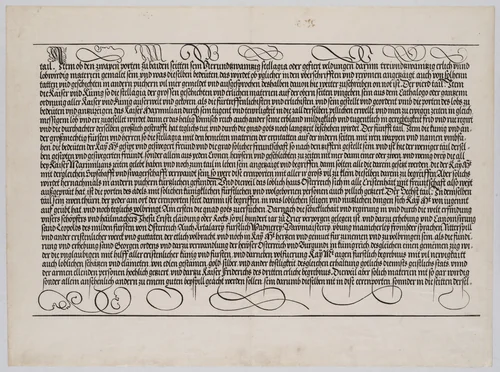
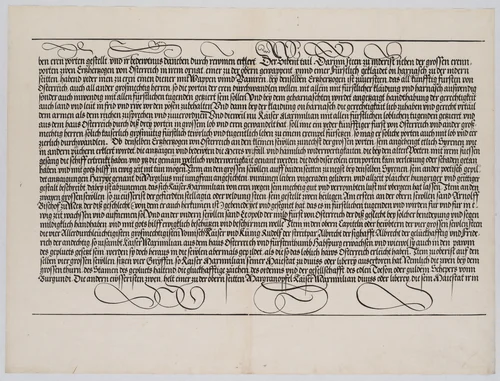
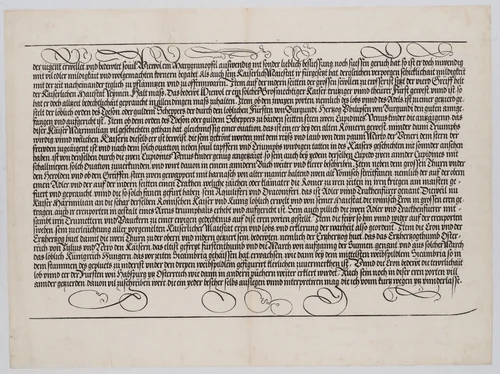
Andreae’s technical skill was most evidently deployed in his contribution to Emperor Maximilian I’s monumental propaganda piece, the Arch of Honor. Designed by Dürer, this imperial commission resulted in what remains perhaps the largest woodcut ever successfully produced, a staggering visual feat assembled from 192 separate blocks. Andreae was instrumental not merely in printing but in the highly sophisticated technical execution required to manage such a gargantuan, multi-part matrix. His precise commitment to documentation is confirmed by the surviving proofs of the explanatory text—five distinct sections, such as Explanatory Text, Part I, from the Arch of Honor—dated 1515 and eventually printed between 1517 and 1518. These works, held in important collections like the Metropolitan Museum of Art, attest to the complexity and scale of his specialized woodcutting involvement.
Beyond his cutting of pictorial material, Andreae fundamentally shaped the aesthetics and mechanics of early modern German print culture through his contribution to typography. He is credited with designing the characteristic German blackletter known as Fraktur. This highly recognizable, intricate typeface became the standard script for German texts for centuries, establishing Andreae’s influence not only in the visual arts but in national literacy and visual identity—a potent reminder of how powerfully the printer’s bench could determine lasting cultural norms. Furthermore, he held notable significance as a pioneering printer of music, ensuring his press contributed equally to both visual and audible culture in the period.
Andreae’s reputation for meticulous attention to detail earned him the occupational nickname 'Formschneider' (shape-cutter), a term rarely applied to a figure of such broad publishing and typological influence. His surviving production provides a vital record of Renaissance print engineering and is often sought by those wishing to acquire high-quality prints reflecting the collaboration between the era's greatest designer and its most accomplished printer. Today, this legacy remains widely accessible, with many rare Hieronymus Andreae prints residing within the public domain.
Source: Wikipedia · CC BY-SA 4.0