Henry Peter Bosse
Henry Peter Bosse (1844–1903) occupies a distinctive place in the history of American photography, bridging the exacting demands of civil engineering with the evolving aesthetics of the late nineteenth century. A German-American cartographer and engineer by training, Bosse’s artistic output arose directly from his professional mandate: to visually document the critical infrastructure and topographical features of the Upper Mississippi River for the U.S. Army Corps of Engineers.
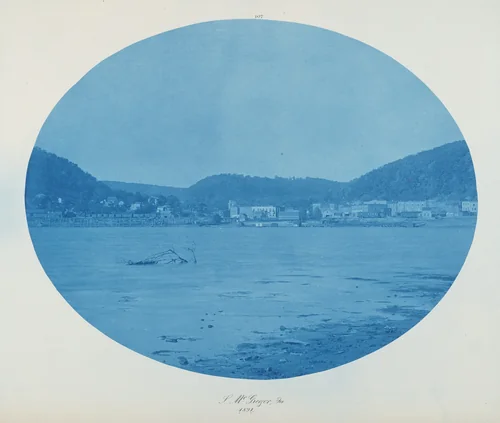
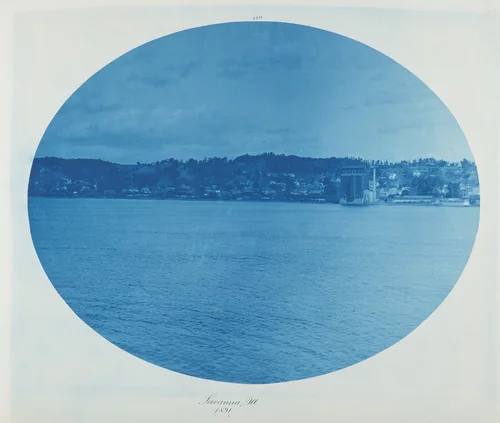
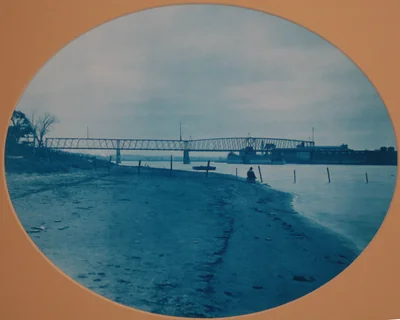
Active primarily between 1885 and 1891, Bosse created a remarkably consistent and high-quality body of work focused on man’s intervention into the landscape. Unlike contemporary photographers who sought the grand, untamed scenic vistas of the West, Bosse concentrated on functional geometry—railroad bridges, navigation aids, and the precise lines of newly built canals designed to control the flow of commerce. His photographs, such as the focused study Bad Axe, Wis. and the imposing C.M. & St. P. RR Bridge at Sabula, Ia., transform necessary administrative records into compelling studies of industrial scale and light.
Bosse was a meticulous practitioner who favored the platinum print process. This technique provided the durability and extraordinarily rich tonal scale necessary to capture the complex reflections and atmospheric conditions along the water, ensuring his work retained its museum-quality detail long after its creation. His technical background as a cartographer—a profession requiring uncompromising precision and spatial awareness—is visibly channeled into his compositions. This pragmatic aesthetic lent his work an observational authority often missing in purely artistic photography of the period.
It is perhaps the greatest irony that one of the most compelling visual histories of American waterborne infrastructure was generated not by an expressive artist, but by a government employee fulfilling his required duty. Nevertheless, his resulting archive is invaluable. Works like Ponton Bridge at Read’s Landing, Minn. and Guard Rock, Des Moines Rapids Canal L.W. offer unparalleled views into a crucial moment of industrial development. Today, this collection, represented in institutions such as the National Gallery of Art, often falls under the public domain, making high-quality prints and downloadable artwork widely accessible for researchers and collectors alike. Henry Peter Bosse’s legacy rests on the elegant, enduring evidence of the necessary meeting between technical skill and subtle, photographic genius.
Source: Wikipedia · CC BY-SA 4.0