Henry Edridge
Henry Edridge (1769-1819) stands as a highly proficient and versatile British artist whose career spanned the transition from late Georgian refinement into the Regency period. Recognized today for his mastery of portraiture, miniature painting, and landscape drawings, his work is preserved in prestigious international collections, including the Rijksmuseum, the Metropolitan Museum of Art, and the National Gallery of Art.
Born the son of a tradesman, Edridge’s formal artistic training began at the foundational age of fifteen when he was apprenticed to William Pether, a notable mezzotinter and landscapist. This early exposure to printmaking techniques and the conventions of scenic representation informed the meticulous draftsmanship that would characterize his later work.
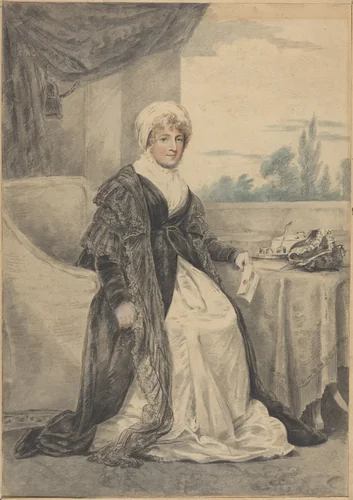
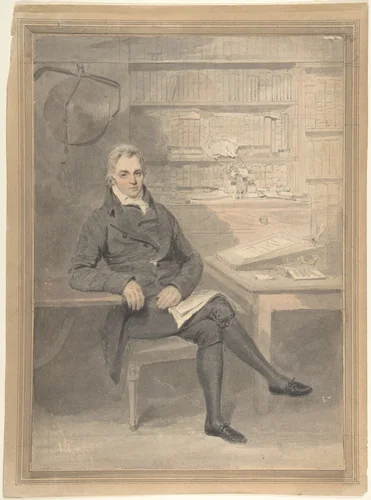
Edridge quickly achieved renown for his skill, successfully navigating the competitive demands of society portraiture. While he was adept at the small-scale precision required for miniatures, his lasting legacy rests primarily on his larger, sophisticated portrait drawings. These works, often utilizing a delicate combination of watercolor, chalk, and pencil, offered detailed and intimate likenesses of prominent contemporary figures. His repertoire was broad, encompassing formal depictions, such as Portrait of a Man, Seated in Front of a Writing Desk, and compelling domestic scenes like Woman Seated at a Table, Holding a Letter.
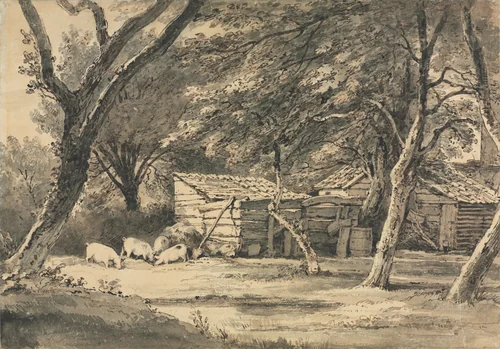
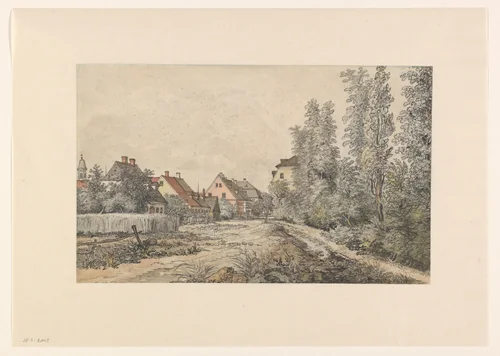
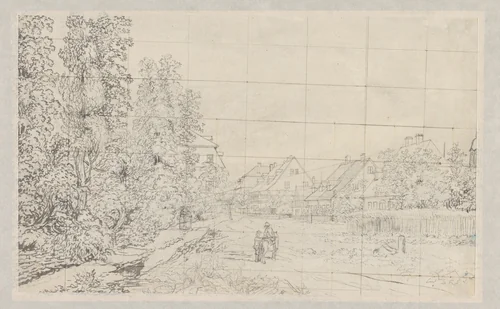
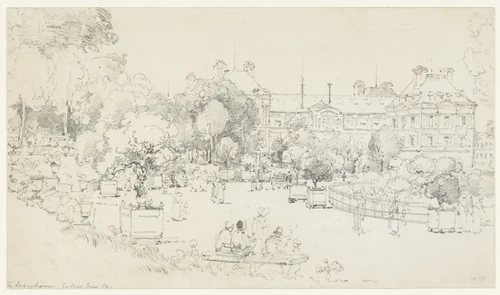
Crucially, Edridge’s artistic curiosity extended beyond the confines of commissioned portraiture. His engagement with pure landscape, evidenced by pieces like Farm with Pigs Foraging and the atmospheric sketches titled Dorpsweg met huizen (in Duitsland?), confirms his technical range. The very ambiguity of the location in some of these landscape titles suggests an artist interested less in strictly accurate topographical reporting and more in capturing the immediate visual and atmospheric sensation of a scene.
His enduring appeal stems from his clear, controlled technique and his ability to fuse the graphic linearity of drawing with the tonality of painting. While the original Henry Edridge paintings and miniatures are prized, many of his meticulous studies and high-quality prints have entered the public domain. The availability of this museum-quality artwork ensures that Edridge’s contribution to early 19th-century British art remains accessible for contemporary study and appreciation.
Source: Wikipedia · CC BY-SA 4.0