Henri Rousseau
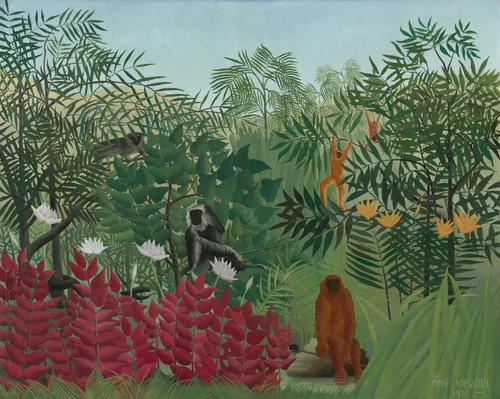
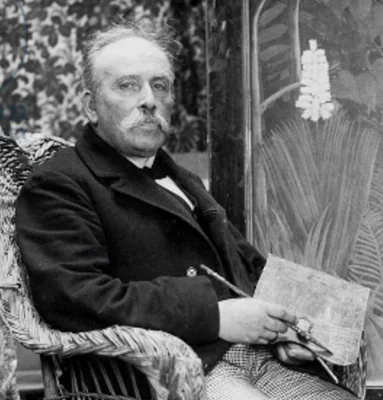
Henri Julien Félix Rousseau (1844-1910) holds a pivotal, though idiosyncratic, position in late 19th and early 20th-century French art. A key figure among the Post-Impressionists, Rousseau is primarily celebrated as the definitive master of the Naïve or Primitive manner. His approach offered a radical counterpoint to the formal academic training of his contemporaries, defined by sharp clarity, flattened perspective, and a startling imaginative coherence. For many years, he was affectionately nicknamed Le Douanier (the toll collector), referencing his long-standing employment as a tax and customs agent in Paris.
Rousseau’s artistic career did not begin until relatively late in life. He started painting seriously in his early forties, managing to balance the rigorous demands of his clerical work with an increasingly intensive studio practice. By age forty-nine, he retired from public service entirely to dedicate himself full-time to his craft. This late-stage dedication speaks to a profound internal commitment, enabling him to produce a distinct body of work, including canvases like Rendezvous in the Forest and preparatory studies. The irony of this meticulous, former civil servant creating some of the most startlingly unreal jungle scenes in art history is a persistent element of his charm.
While often known for his dense, hypnotic jungle scenes, Rousseau also applied his distinct, meticulous style to intimate Parisian views, such as Sawmill, Outskirts of Paris, and everyday urban landscapes like River and Park Landscape. His output was modest but impactful, consisting of approximately seven surviving prints, six major paintings, and several drawings created over his active period spanning the 1860s through 1902.
Today, the enduring power and originality of his vision are preserved in leading institutions globally, including the National Gallery of Art, the Museum of Modern Art, and the Art Institute of Chicago. The lasting cultural impact of his work means that many of these Henri Rousseau paintings are now considered foundational modernist examples. His original compositions, increasingly accessible for study and appreciation, are widely available as high-quality prints through the public domain.
Source: Wikipedia · CC BY-SA 4.0