Henri Louis Duhamel du Monceau
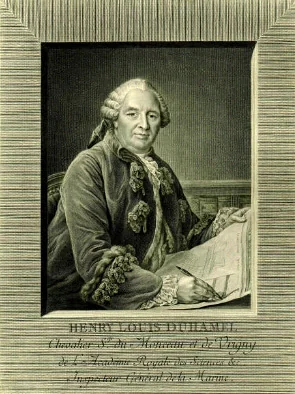
Henri Louis Duhamel du Monceau (1715-1782) occupied a unique and authoritative position in 18th-century French scientific culture. A highly accomplished polymath, his formal expertise spanned naval engineering, medicine, and botany. Although he is formally recognized by the scientific world via the standard author abbreviation ‘Duhamel’ when citing a botanical name, his most visually enduring legacy lies in the rigorously detailed publications he produced and supervised. His dedication to empirical observation led to a body of work that transcended mere scientific documentation, establishing a high watermark for natural history prints during the Enlightenment period, active between 1768 and 1808.
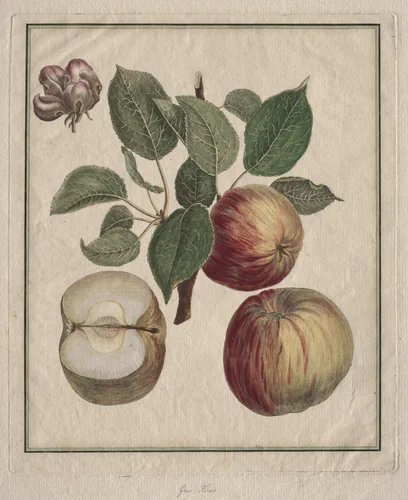
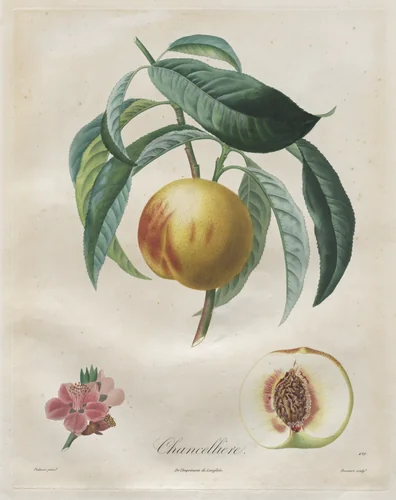
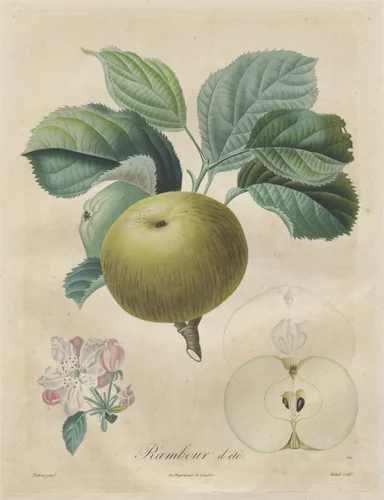
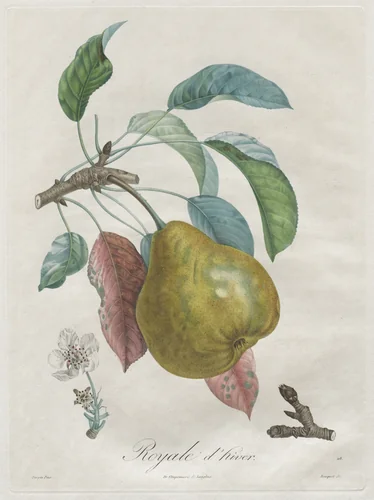
Duhamel du Monceau's greatest artistic and scientific contribution is epitomized by the monumental Traité des arbres fruitiers. This comprehensive series provided essential, life-size records of cultivated fruit varieties, capturing the subtle variations in form and color necessary for accurate identification and propagation across the French agricultural landscape. Specific examples, such as Apple with Leaf and Fruit Blossom and the precise recording found in Traité des arbres fruitiers: Rambour d’été, demonstrate the painstaking detail applied to each plate. These works served simultaneously as sophisticated scientific instruments and objects of remarkable clarity, translating complex botanical structures into accessible visual language for specialists and horticulturists alike.
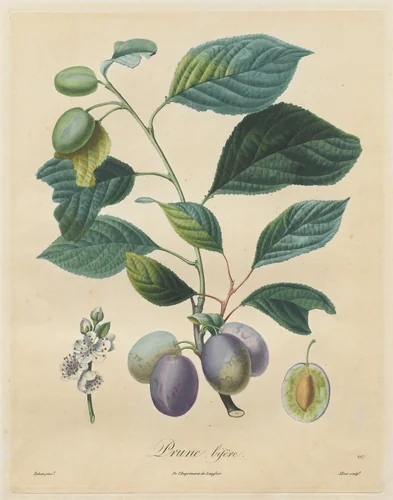
For Duhamel, precision was not merely a preference; it was a scientific imperative. The final prints required an exacting balance between scientific fidelity and aesthetic appeal, ensuring that unique characteristics, like the texture of the Prune bifère or the exact morphology of the Royal d’hiver pear, were captured with unwavering accuracy. This productive blending of disciplines reflects the era’s ambitious drive to catalogue and master the entire natural world. It is perhaps a gentle irony that a man known equally well for his influential treatises on designing ships and documenting medicinal plants is now primarily appreciated by the wider public for the perfect, timeless curves of a high-quality print depicting a pear.
These museum-quality illustrations remain highly valued for their historical significance and visual integrity, preserving critical scientific data alongside striking graphic design. Today, collections like the Cleveland Museum of Art ensure these examples of eighteenth-century botanical art endure. The original plates and subsequent royalty-free images derived from them are increasingly available as downloadable artwork, confirming that the visual contributions of Henri Louis Duhamel du Monceau prints continue to educate and inspire appreciation worldwide.
Source: Wikipedia · CC BY-SA 4.0