Henri Gaudier-Brzeska
Henri Gaudier-Brzeska (1891-1915) occupies a unique and significant, if tragically short-lived, place in the history of European Modernism. Though French by birth, his major output occurred in London between 1909 and his death in the trenches during World War I, rendering his mature active period a mere five years. Primarily a sculptor, Gaudier-Brzeska rejected the academic tradition of preparatory modeling and casting, pioneering instead a rough-hewn, primitive style achieved through the intensive process of direct carving. This commitment to material honesty and immediacy defined his aesthetic identity and positioned him at the forefront of the pre-war avant-garde.
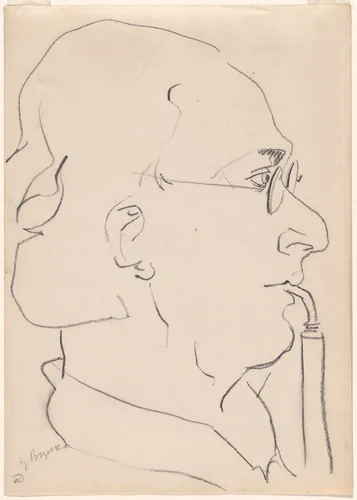
The artist operated at the very epicenter of London’s artistic ferment. His close affiliation with critic Ezra Pound and artist Wyndham Lewis, whose Portrait of Wyndham Lewis he captured in a dynamic drawing, situated him within the orbit of the burgeoning Vorticism movement. Although he shared the Vorticists’ fascination with energy and force, his sculptural output retained a raw, organic edge that often contrasted with their more severe, mechanical geometry. His focus was consistently on the tensile strength of the figure, whether carved in stone or executed in ink.
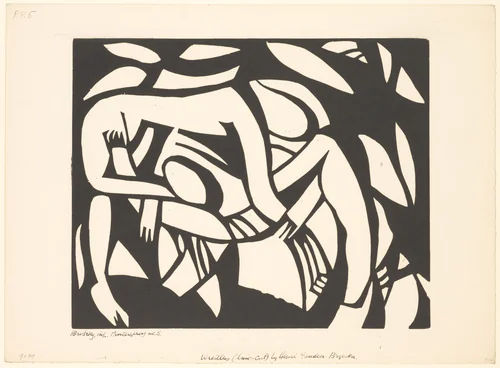
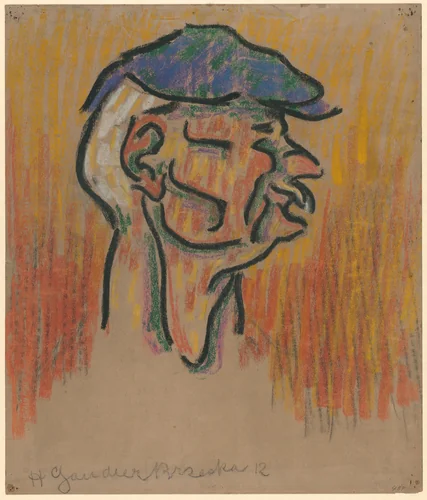
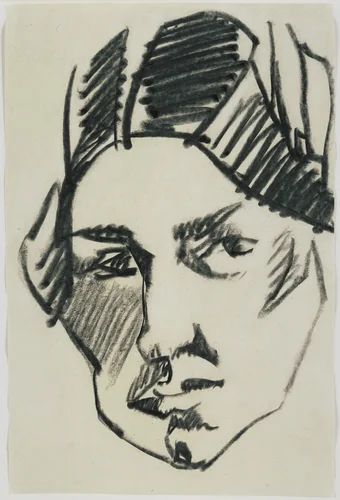
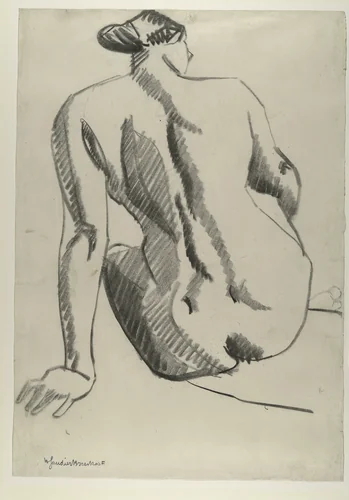
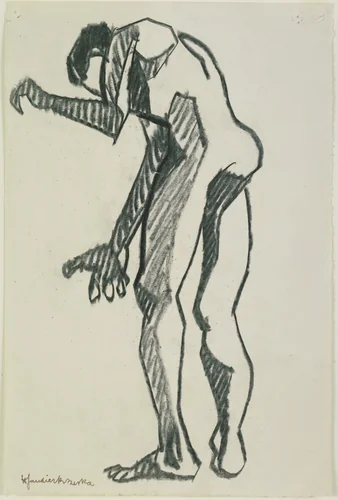
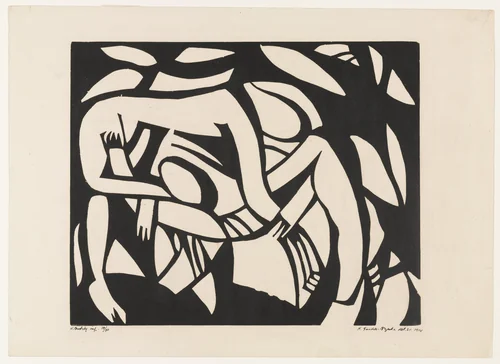
Gaudier-Brzeska was equally adept with line as he was with volume. His graphic works, such as the charged sketches Wrestlers and A Labourer (Man with Cap), demonstrate the same muscularity and reductive power that characterize his three-dimensional forms. His ability to distill human movement into essential, powerful lines suggests an artist constantly seeking the primal force beneath the surface, a characteristic visible even in subtler studies like Seated Nude, Back-View.
A remarkable aspect of Gaudier-Brzeska’s intense productivity is the sheer density of output within such a compressed timeframe, a pace that suggests an artist in a perpetual state of creative acceleration. Despite his curtailed career, he achieved notable representation in major American institutions, with important early works held in the Museum of Modern Art and the Metropolitan Museum of Art. For scholars studying the pivot from early Cubism to native British modernism, Gaudier-Brzeska prints and drawings provide invaluable insight. Today, many of these influential works are held in the public domain, making high-quality prints and reproductions widely accessible for study and exhibition.
Source: Wikipedia · CC BY-SA 4.0