Hendrik Jacobus Scholten
Hendrik Jacobus Scholten (active 1834-1887) was an accomplished Dutch painter whose work provides a detailed perspective on 19th-century Netherlandish visual culture. Though the documented catalog of his surviving professional output is modest, comprising four known prints, two drawings, and a singular painting, the institutional holding of his works, notably at the Rijksmuseum, establishes his historical significance within the era’s established art currents.
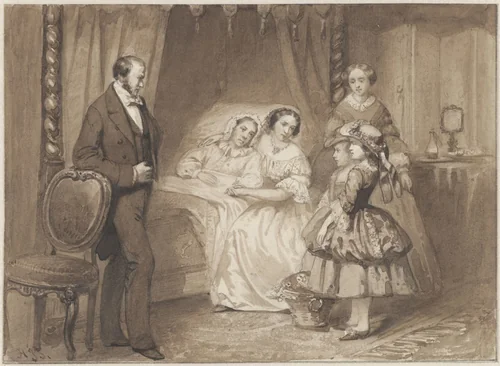
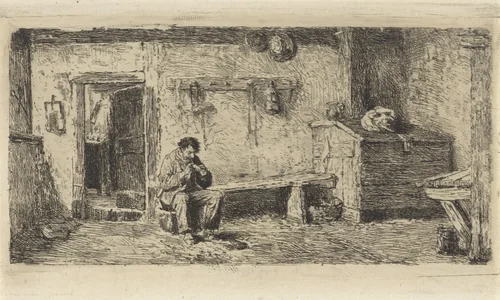
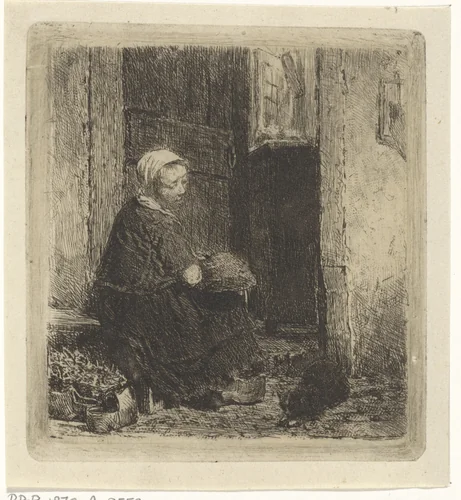
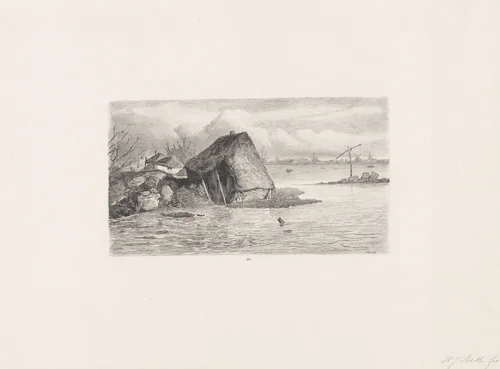
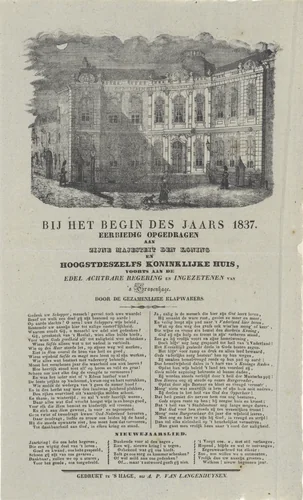
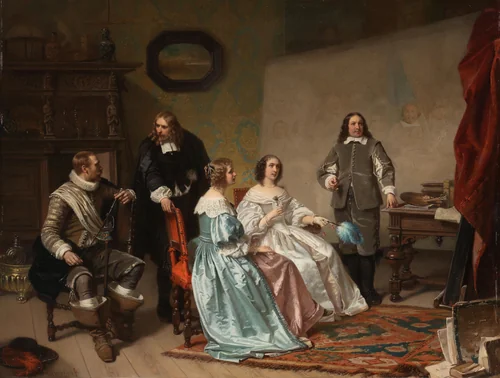
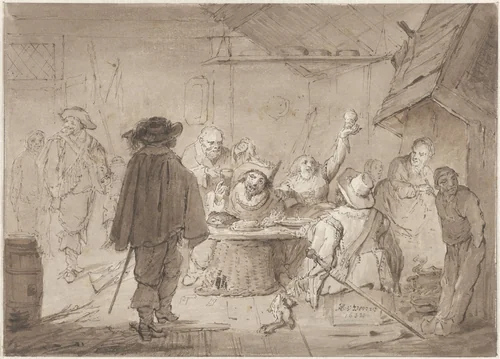
Scholten demonstrated a facility for capturing both intimate domesticity and formal architecture with practiced precision. His genre scenes often focus on quiet, ordinary observation, as evidenced in the character study Pijprokende man in een schuur and the tender, narrative quality of De verjaardag der zieke grootmoeder. Yet, his capacity for detailed topographical work is equally strong. The rendering of the urban landscape in Paleis Kneuterdijk, Den Haag, serves as a valuable historical record, capturing the imposing architecture of the Hague with an objective eye. This duality, moving seamlessly from the quiet focus required for depicting a subject like Vrouw met een kat to the structural challenge presented by Overstromingsgebied met ingestort huis, suggests a rigorous training and versatility prized by patrons of the time.
A subtle but defining characteristic of Scholten’s output lies in his ability to imbue everyday moments with an almost documentary gravitas. While many 19th-century artists focused either strictly on high-genre drama or stylized realism, Scholten’s best work often bridges the gap, allowing for narrative interpretation without sacrificing factual observation.
As with many artists from this era, accessibility to his output has evolved. Surviving examples of Hendrik Jacobus Scholten paintings and drawings, alongside his documented body of high-quality prints, continue to inform studies of Dutch fine arts history. While some originals remain in established collections, the distribution of his images has broadened, ensuring that his visual contribution to the 19th century remains available for future generations of historians and enthusiasts.
Source: Wikipedia · CC BY-SA 4.0