Hans Rudolf Manuel Deutsch
Hans Rudolf Manuel Deutsch (1525-1571) was a highly accomplished Swiss draughtsman and printmaker whose primary significance lies in his contribution to sixteenth-century scientific and geographical illustration. Active primarily between 1545 and 1564, Deutsch worked almost exclusively in the demanding medium of the woodcut, producing highly technical and detailed imagery that served as a crucial visual complement to the era’s most ambitious scholarly texts.
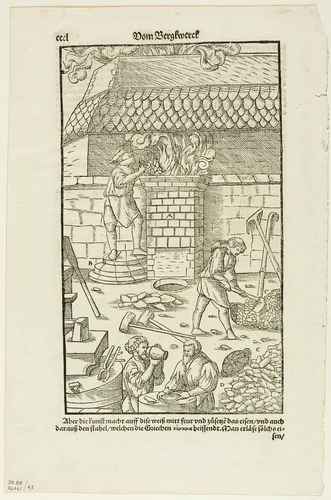
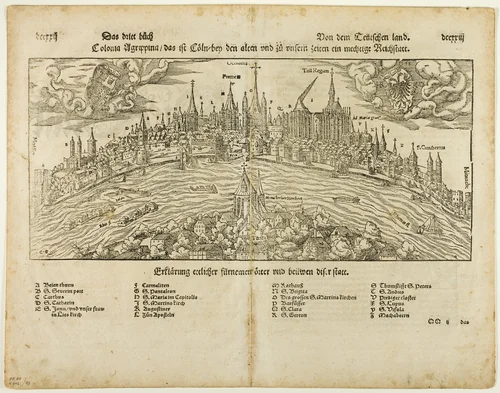
His career is defined by his extensive involvement in two foundational monuments of Renaissance knowledge. Deutsch executed several key plates for Georgius Agricola’s De re metallica (1556), the definitive early modern treatise on mining, metallurgy, and assaying. These illustrations were not merely decorative; they required exacting precision to depict complex industrial mechanisms and geological processes accurately, establishing a new benchmark for technical visualization in print. Concurrently, he provided vital views and maps for multiple editions of Sebastian Münster’s influential encyclopedia, Cosmographia (first published 1544). These works placed him at the vanguard of documentary printmaking, allowing broad audiences access to topographical data, such as the comprehensive View of Cologne and various cartographic components.
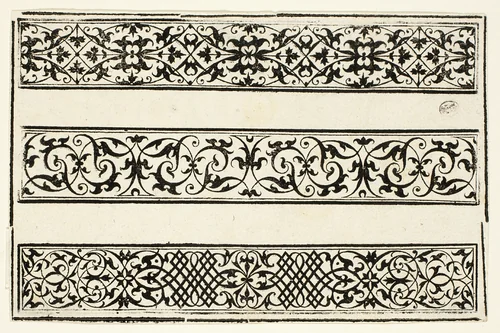
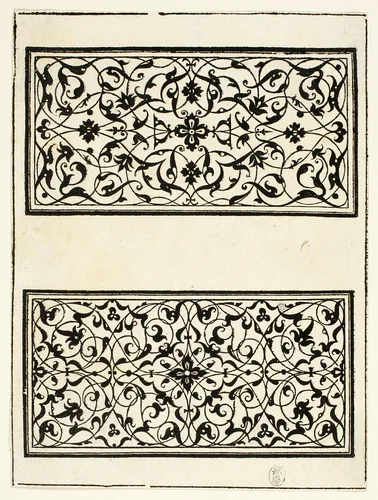
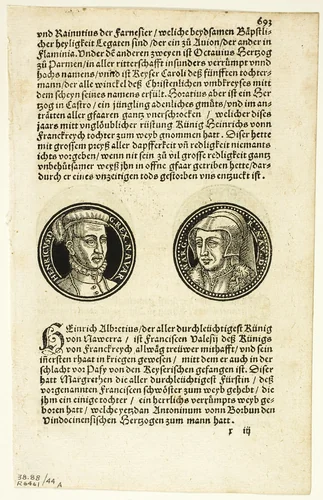
Deutsch’s visual lexicon was notably versatile. He moved seamlessly from the rigorous demands of technical cross-sections to sophisticated decorative elements, exemplified by the intricate strapwork and grotesques visible in his Ornamental Panels. His output also includes historical imagery, such as the Medallion Portraits of Henry and Margaret of Navarre, illustrating his capability in formalized portraiture designed for textual integration. A more unsettling, yet characteristic, dimension of his work surfaces in contrasting images like the Man Hanged from a Tree, sometimes found on the verso of his broader topographical views, revealing a quiet awareness of the contemporary political reality.
Though much of his known output remains bound within the pages of these weighty volumes, the lasting museum-quality of his craftsmanship ensures his survival outside of rare book collections. Today, researchers and enthusiasts seeking Hans Rudolf Manuel Deutsch prints benefit greatly from digitization initiatives; high-quality prints and downloadable artwork are frequently available from major institutions like the Art Institute of Chicago. As a prolific visual contributor to the golden age of descriptive printing, Deutsch was an effective agent in disseminating essential technical and historical knowledge across Europe, and much of his work has entered the public domain, guaranteeing his continued scholarly relevance.
Source: Wikipedia · CC BY-SA 4.0