Günther Zainer
Günther Zainer holds a foundational and pioneering place in the history of German typography. He established the first permanent printing press in Augsburg, operating there from his arrival in 1468 until his death. Hailing originally from Strassburg, Zainer rapidly transformed Augsburg into a major intellectual and commercial center for book production during the volatile early decades of mechanized printing.
His tenure was marked by both prolific output and crucial technical innovation. Zainer is credited with producing approximately eighty distinct titles, demonstrating a comprehensive approach to the market. This remarkable catalogue includes two influential German editions of the Bible, which played an overlooked role in linguistic standardization, and notably, the printing of the city’s first calendar. This move signaled Zainer’s keen understanding of the commercial potential of print extending beyond purely academic or religious texts.
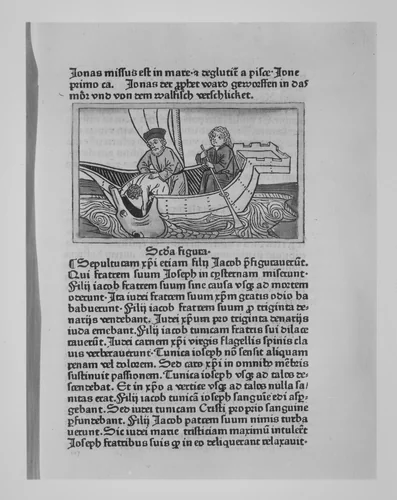
Zainer’s most enduring contribution to visual culture, however, lies in his pioneering integration of image and text within large, bound volumes. While woodcuts were common in isolation, Zainer was the first German printer to successfully merge substantial illustration with complex typography. Between 1471 and 1476, he undertook Jacobus de Voragine’s seminal collection of hagiographies, the Legenda aurea. This ambitious two-volume work utilized 131 separate woodcuts, setting a definitive precedent for illustrated narrative publication and elevating the artistic complexity available to the burgeoning audience.
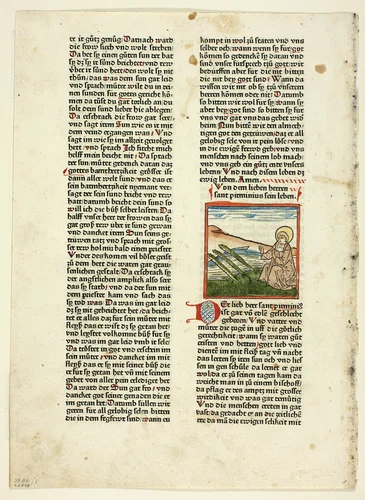
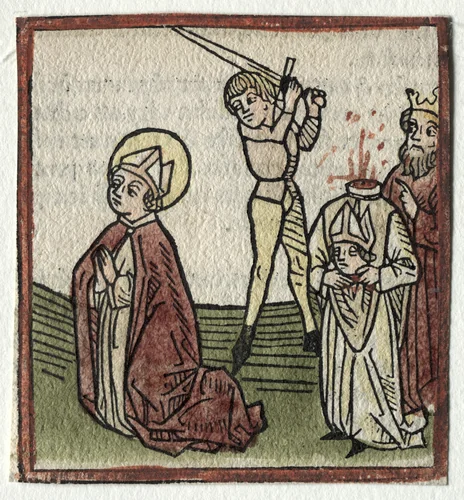
His meticulous craftsmanship ensured the longevity of his enterprise. Zainer’s operation produced high-quality prints, evident in surviving individual leaves like the Life of Saint Pirminius or devotional pieces such as St. Marcarius. These works are now preserved in major institutional holdings, including the Metropolitan Museum of Art and the Art Institute of Chicago. The Zainer family appears to have orchestrated a coordinated expansion across the region; the contemporary establishment of Johann Zainer as the first printer in Ulm suggests a familial recognition of the strategic importance of this new technology. For scholars and connoisseurs seeking access to these foundational designs, digital copies of Zainer's early influential work are frequently found in the public domain, ensuring his legacy remains easily studied.
Source: Wikipedia · CC BY-SA 4.0