Guillaume-Benjamin-Amand Duchenne
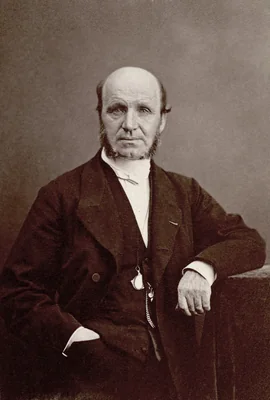
Guillaume-Benjamin-Amand Duchenne (1806-1875) stands as one of the pivotal figures in the development of modern neurology, primarily through his innovative application of electrical currents to study and diagnose human physiology. He is credited with reviving Luigi Galvani's research and significantly advancing the science of electrophysiology. His enduring historical and artistic significance, however, rests equally upon his rigorous, pioneering use of clinical photography as a tool for visual documentation and precise expressive analysis.
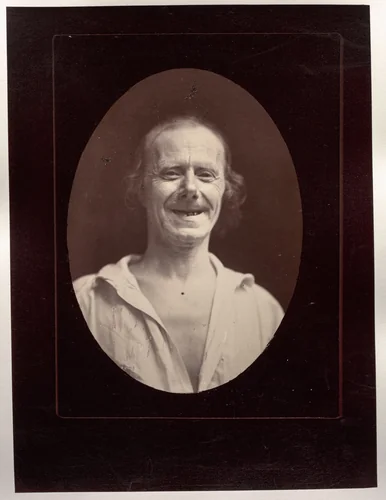
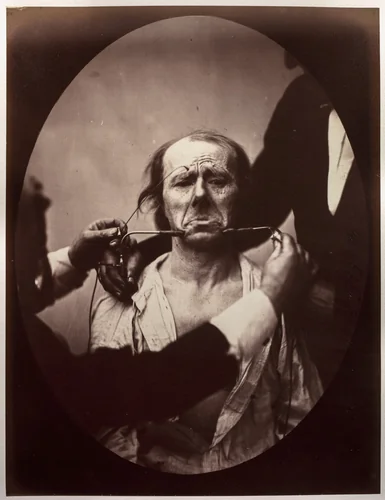
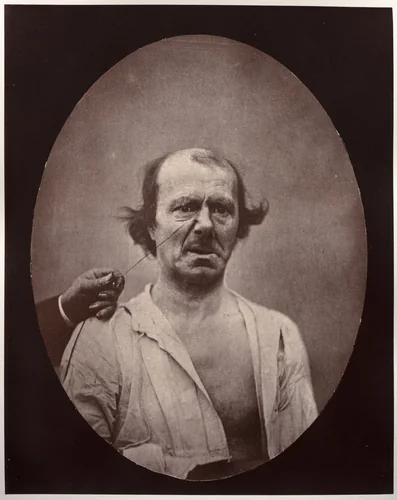
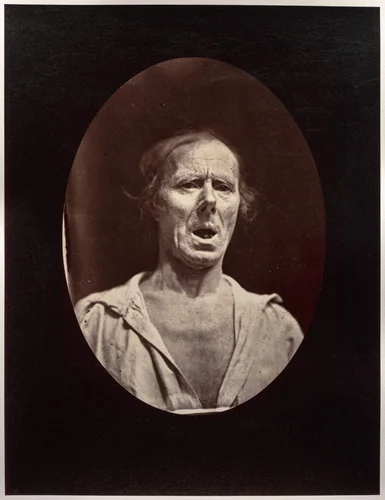
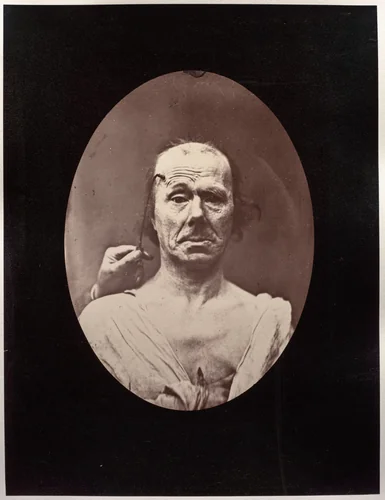
Duchenne’s seminal visual achievement, documented in Mécanisme de la Physionomie Humaine (1862), transformed the study of human emotion. Using galvanic currents delivered by electrodes placed on the faces of his subjects, Duchenne meticulously chartered the muscular mechanisms responsible for generating expressions ranging from profound grief to natural joy. The resulting photographs are a fascinating synthesis of dispassionate anatomical science and unsettling portraiture, establishing a new, objective standard for visual diagnosis.
The works, now held in major collections such as the Cleveland Museum of Art, function less as psychological insights and more as precise anatomical diagrams rendered in albumen print. Titles reflect this clinical exactitude: Figure 45: Contraction électrique forte des triangulaires des lèvres et des sourciliers: douleur et déspoir details mechanically induced suffering, while Figure 32: Natural laughter by the voluntary contraction of the two large zygomatics and the lower palpebral orbicularis attempts to mimic genuine pleasure. Other studies, like Figure 51: À droite, contraction partielle de l'élévateur commun de l'aile du nez et de la lèvre supérieure: mécontentement, mauvaise humeur; à gauche, repos, demonstrate the subtle complexity of partial muscular movements.
Duchenne’s contributions extended far beyond the camera lens, encompassing diagnostic innovations such as deep tissue biopsy and early nerve conduction tests (NCS). This extraordinary, multi-faceted range of work was achieved against the background of a notably troubled personal life and a medical and scientific establishment that was often indifferent to his discoveries. It is an interesting dichotomy that the man who so clinically mapped the mechanisms of despair and joy often struggled against professional obscurity. Nevertheless, Duchenne’s photographs are recognized today for their profound, museum-quality detail. Many of these important historical documents reside in the public domain, allowing for high-quality prints to circulate and influence visual culture long after their original scientific purpose was satisfied.
Source: Wikipedia · CC BY-SA 4.0