Guglielmo Caccia
Guglielmo Caccia (1500-1583), known by his lasting appellation il Moncalvo, was a prolific Italian painter who specialized in sacred subjects during the sixteenth century. Operating primarily in Piedmont, his lengthy career intersected with the high point and subsequent transition of the Italian Mannerist movement. Caccia’s output was characterized by the elegant elongation and heightened emotional clarity typical of the style that succeeded the High Renaissance, granting him significance across several decades of profound shifts in devotional art.
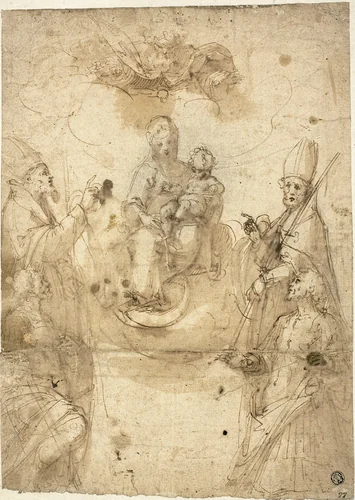
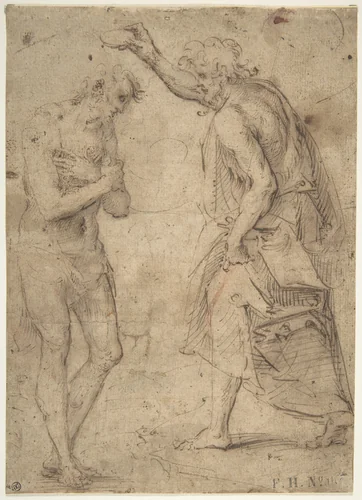
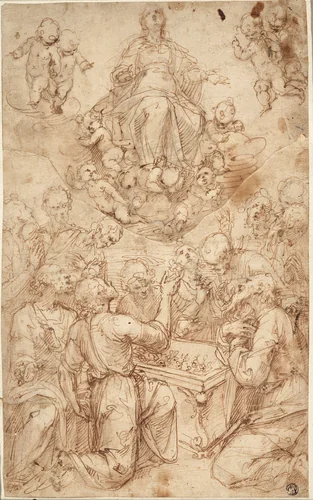
While renowned in his time for monumental altarpieces, Caccia’s mastery of draftsmanship is most clearly demonstrated through his surviving graphic work. Major American institutions, including the Art Institute of Chicago and the Metropolitan Museum of Art, hold key examples of his compositional studies. These works illustrate his versatility, ranging from grand narrative scenes like Madonna and Child with Adoring Saints and the focused drama of The Baptism of Christ, to highly detailed ornamental schemes.
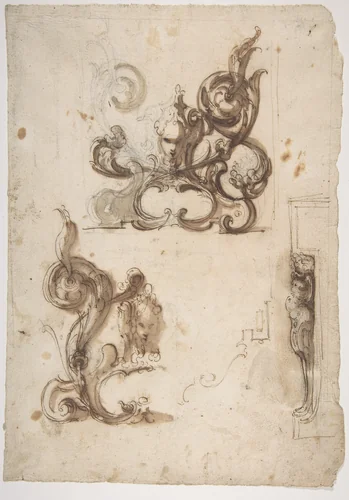
A particularly interesting aspect of his studio practice is evidenced in sheets such as Designs for Ornamental Motifs and for a Herm Supporting a Chimney Piece. That an artist known for moving sacred history paintings dedicated such careful precision to architectural fittings is a subtle reminder that even the most spiritually focused painters were often the era’s most effective masters of high-end interior design. The technical facility and compositional rigor displayed in his sketches ensured that Guglielmo Caccia paintings became models for succeeding generations across Northern Italy.
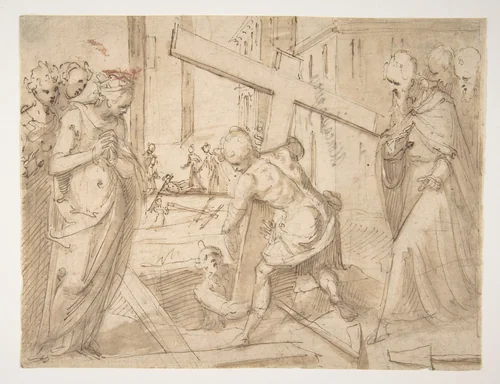
Caccia’s enduring appeal rests on the blend of technical confidence and emotional sincerity he brought to the stylized forms of Mannerism. For students of the period, his detailed drawings, often rendered in rich pen and ink, offer valuable primary material into sixteenth-century creative processes. Today, high-quality prints and detailed studies of these works, including preparatory compositions for paintings such as The Discovery of the True Cross, are frequently made available by collecting institutions. Many of these foundational artistic documents are now in the public domain, guaranteeing that the legacy of il Moncalvo remains accessible to researchers and enthusiasts worldwide.
Source: Wikipedia · CC BY-SA 4.0