Giuseppe Cades
Giuseppe Cades (1750-1795) was an exceptionally versatile Italian artist, achieving success across the discrete fields of painting, sculpture, and engraving during a transformative period in European art history. Operating primarily in Rome, Cades began his career firmly rooted in the decorative exuberance of the late Rococo, but quickly adapted his style to embrace the growing intellectual rigor of the nascent Neoclassicism. This ability to mediate between styles secured him significant patronage and institutional recognition.
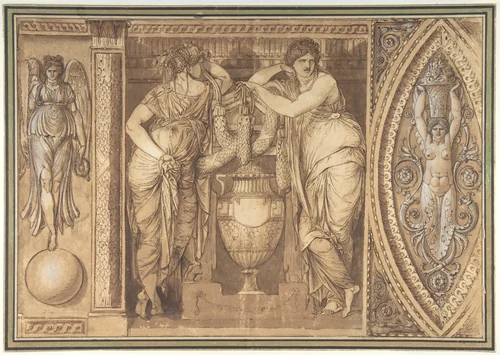
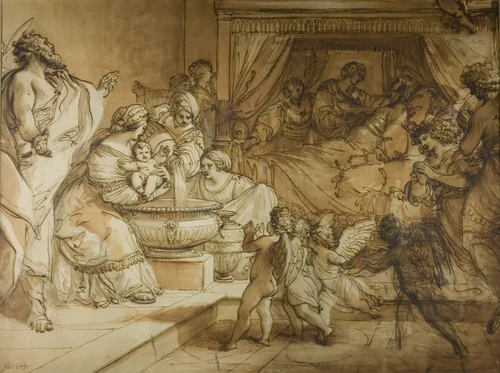
Cades’s true mastery is often best observed in his copious output of preparatory and finished drawings. As an outstanding draftsman, he possessed a fluid yet precise technique capable of rendering both the intimate detail required for subjects like Designs for Vases [verso] and the complex, dramatic action seen in Sacrifice [recto]. He successfully blended references to masters of the High Renaissance and the Baroque with an immediacy that spoke directly to contemporary taste.
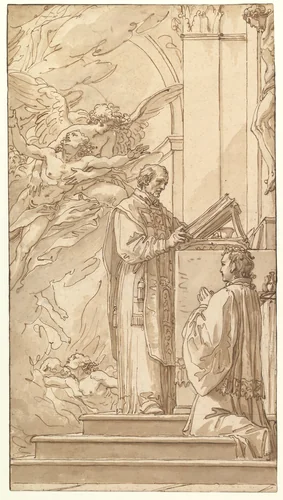
His commissions spanned religious and mythological subjects, ensuring the display of his compositions in diverse settings. Works such as Blessed Francis Venimbeni Celebrating Mass for souls in Purgatory exemplify his skill in handling large-scale devotional painting, employing dramatic lighting and carefully composed figures to convey spiritual narrative. Simultaneously, his printmaking activity, evident in works categorized as Giuseppe Cades prints, ensured the wide dissemination of his designs, functioning as crucial educational tools and collectible artifacts throughout Italy and beyond.
The scope of his artistic activities, shifting between the grand rhetoric of painting and the meticulous precision of engraving, made him a revealing barometer of late 18th-century Roman aesthetic demands. It is perhaps the subtle brio Cades maintained even in his most serious compositions—an understated energy that resists complete subordination to academic strictures—that preserves the individuality of his work. Today, his pieces are preserved as museum-quality examples of late 18th-century graphic arts in major institutions worldwide. Fortunately, much of his extensive graphic material has entered the public domain, making high-quality prints and downloadable artwork accessible to scholars and admirers globally.
Source: Wikipedia · CC BY-SA 4.0
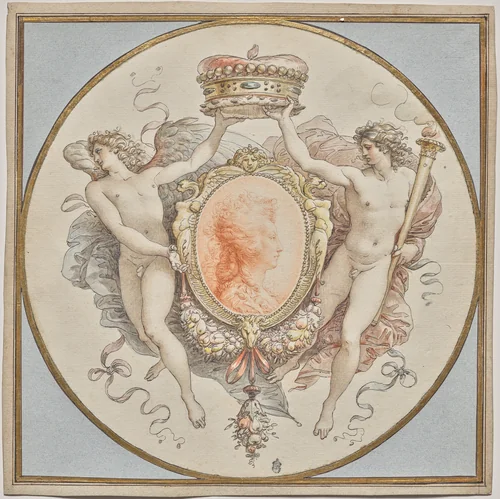
![Designs for Vases [verso] by Giuseppe Cades, drawing, 1750-1799](https://img.artbee.org/037f54d6-7ae7-4398-aa53-bf3605868cea/small.webp)
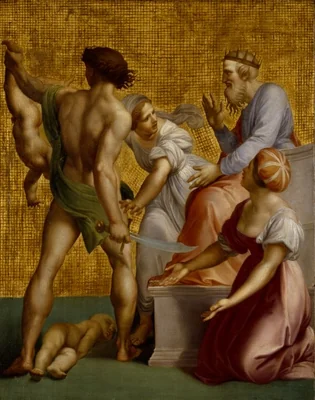
![Sacrifice [recto] by Giuseppe Cades, drawing, 1750-1799](https://img.artbee.org/fdb10477-5874-45d8-bd87-3bfa2dd42637/small.webp)