Giovanni Paolo Panini
Giovanni Paolo Panini (1691-1743) was an influential Italian Baroque figure who flourished primarily in Rome, recognized equally as an architect and a foundational painter. His enduring significance rests upon his masterful contribution to the veduta or view painting tradition, establishing him as one of the period’s preeminent vedutisti. Panini specialized in large-scale vistas of Rome, focusing with particular enthusiasm on the architectural remnants of its classical past.
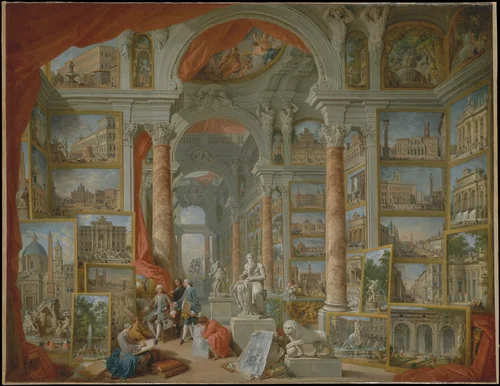
Unlike contemporaries preoccupied solely with topographical precision, Panini elevated the Roman vista, offering the 18th-century Grand Tourist a romanticized, yet scholarly, encounter with antiquity. His most celebrated subjects include the grand interior of the Pantheon and his remarkable gallery vedute, which served as imaginative compilations of other views of Rome’s antiquities within a single framed painting.
Panini is perhaps best recognized for his mastery of the capriccio, a genre that allowed for the imaginative placement of real architectural elements within a fanciful or unreal setting. In compositions such as Figures in Classical Ruins, his depiction of crumbling Roman monuments features a calculated theatricality and a subtle sense of pictorial invention, echoing the stylistic flourishes found in the capricci of Marco Ricci. This synthesis of the factual and the fantastical lends the works a compelling decorative quality, appealing deeply to elite patrons seeking idealized souvenirs of the Eternal City.
His versatility extended beyond ruins and cityscapes; the artist also produced important official portraiture, including a notable depiction of Pope Benedict XIV, confirming his position within the Roman artistic hierarchy. Panini’s meticulous detail and ability to stage sophisticated visual narratives ensure his status as a key transitional figure in eighteenth-century painting. Today, Giovanni Paolo Panini paintings are cornerstones of major international collections, including the National Gallery of Art and the Art Institute of Chicago. As many of his finest images have entered the public domain, enthusiasts can readily access high-quality prints and downloadable artwork derived from his monumental output.
Source: Wikipedia · CC BY-SA 4.0