Giovanni Girolamo Savoldo
Giovanni Girolamo Savoldo, often identified as Girolamo da Brescia, stands as a crucial yet singular figure within the Italian High Renaissance. Active primarily between 1510 and 1530, his career centered in Venice, though his influence resonated throughout Northern Italy. Savoldo is distinguished by his departure from the purely ornamental splendor often associated with the Venetian school, instead channeling a profound and sober realism into his compositions.
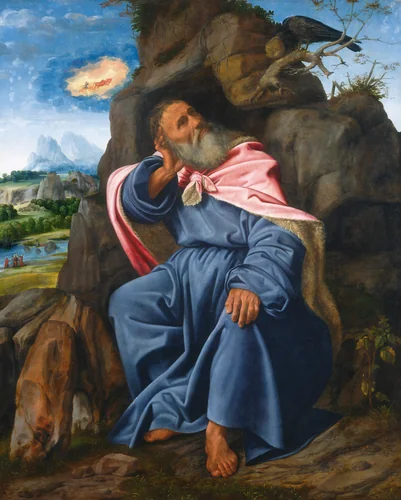
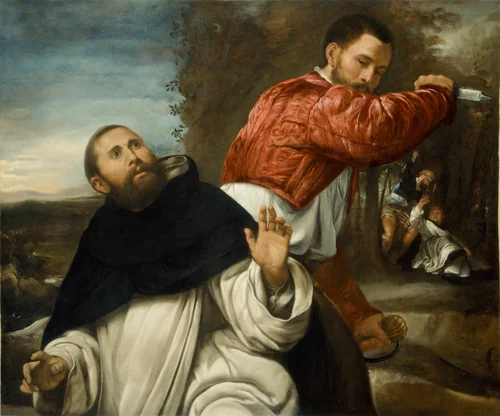
His technical mastery hinged upon an innovative use of light and shade. Savoldo’s chiaroscuro is not merely descriptive; it is psychological, deployed to generate emotional depth and dramatic tension in his predominantly religious subjects. Works such as Elijah Fed by the Raven and The Death of St. Peter Martyr exemplify this approach, using abrupt contrasts of light to highlight intense moments of spiritual encounter or martyrdom. This technical rigor, combined with a subtle deployment of color, ensured his place among the most sophisticated colorists of the era.
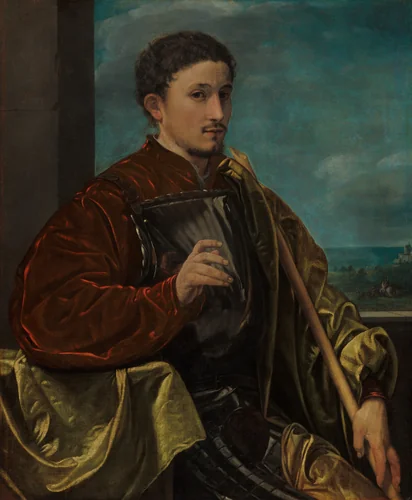
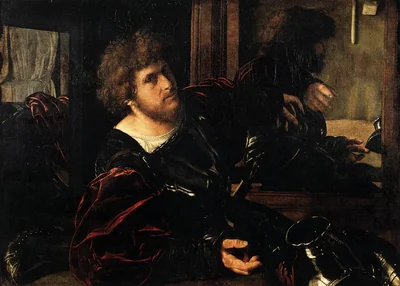
While recognized chiefly for his altarpieces and devotional imagery, Savoldo’s relatively small number of known portraits reveal an intriguing narrative sensibility. Instead of traditional static representations, he frequently situated his sitters, such as the subject of the Portrait of a Knight, within atmospheric settings, employing enigmatic accessories or backdrops. These elements transform the likenesses into visual excerpts, giving the viewer the distinct impression that the figure has been extracted directly from a larger, unfolding story.
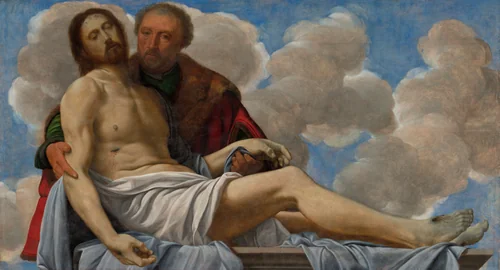
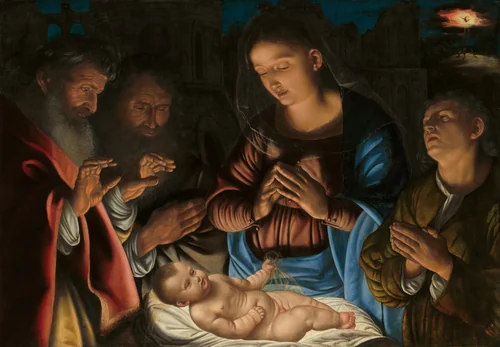
Savoldo’s work, including major pieces like Christ with Joseph of Arimathea and The Adoration of the Shepherds, profoundly influenced the subsequent generation of Lombard and Venetian painters. Despite the relative scarcity of extant Giovanni Girolamo Savoldo paintings, their quality ensures his legacy. Today, several of his key works are held in premier collections, including the Art Institute of Chicago and the National Gallery of Art. Fortunately, much of his artistic output resides within the public domain, making museum-quality digital files and high-quality prints widely available for scholarly review and contemporary appreciation.
Source: Wikipedia · CC BY-SA 4.0