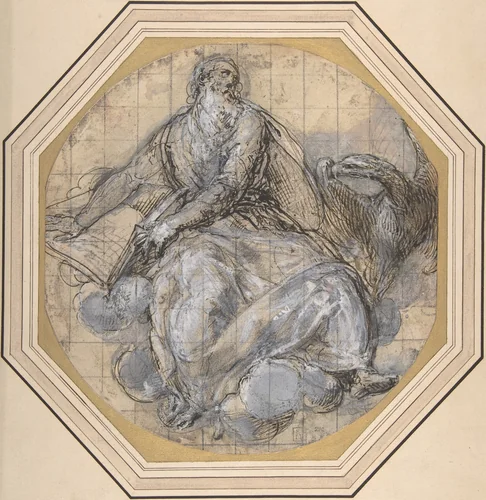
Giovanni de' Vecchi
Giovanni de’ Vecchi was an Italian painter who played a significant, if often understated, role during the late Renaissance period. Active from approximately 1536 until his death in 1598, his career spanned the transition from High Renaissance classicism into the heightened theatricality and complexity of Mannerism. While comprehensive records of his finished frescos or altarpieces are sometimes scarce, his lasting contribution is cemented by the extensive collection of his preparatory drawings and detailed designs, which showcase a profound compositional mastery.
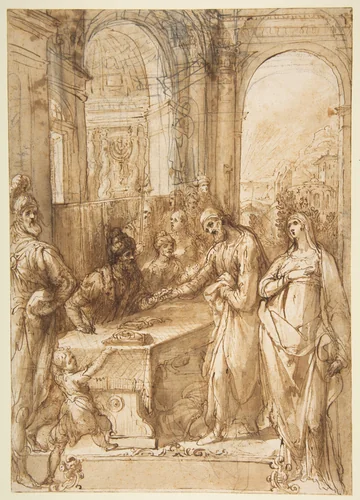
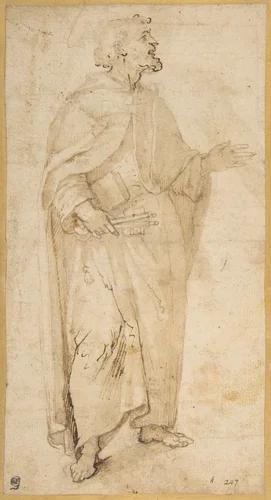
His surviving works, held in distinguished collections including the Metropolitan Museum of Art and the Cleveland Museum of Art, reveal an artist deeply focused on Biblical and devotional narratives. His studies, such as the dynamic Esther and Mordecai before King Ahasuerus and the intensely modeled Standing Figure of Saint Peter Holding Book and Keys, demonstrate a clear structural approach to the human figure and an economy of line that was essential for successful large-scale projects. De’ Vecchi’s preparatory sketches served not merely as outlines but as fully realized blueprints.
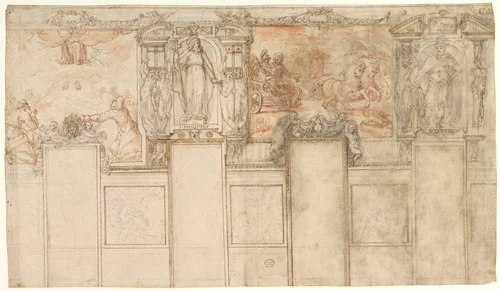
The complexity of his proposed commissions is evident in drawings like Design for a Wall Decoration: Representations of the Ascension and of the Conversion of the Ethiopian Eunuch. Such pieces illustrate the technical demands placed upon sixteenth-century artists, who had to integrate multiple distinct narrative scenes seamlessly within unified architectural frameworks. It is perhaps an understated observation that, in an era dominated by large-format painting, the true measure of a master draughtsman often lies in the quality of his initial thought process captured on paper.
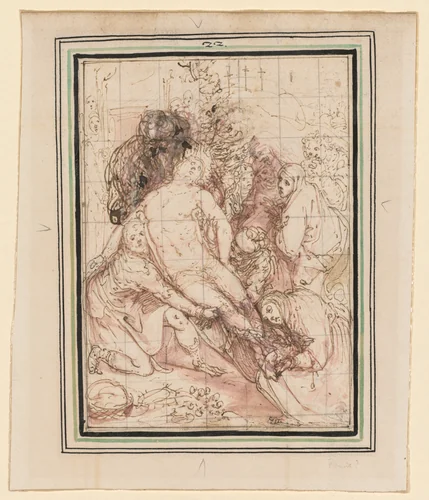
The existence of numerous Giovanni de' Vecchi prints, often documenting these complex preparatory stages, offers invaluable insights into the workshop practices of the late Cinquecento. Today, many of his compelling religious studies, including The Entombment and Saint John the Evangelist, have entered the public domain. This accessibility allows scholars and enthusiasts worldwide to acquire high-quality prints for personal study, affirming de’ Vecchi’s status as a foundational, if sometimes overlooked, figure whose meticulous hand helped define the visual culture of late Renaissance Rome.
Source: Wikipedia · CC BY-SA 4.0